
salivary gland
 3
4.0
3
4.0

- noun
- /ˈsælɪˌvɛri ɡlænd/
- Specialized
- During the procedure, the doctor examined the patient's salivary glands for any signs of infection.
- minor salivary glands
- salivary gland biopsy
- salivary gland tumor
Examples
-
Adults and children with salivary gland enlargement seem to experience slower progression of HIV disease.
Academic text (2000) -
At this point, the sublingual salivary gland was recognized and appeared normal.
Academic text (2008) -
In order to fuel their specialized salivary glands, the males must eat well.
Academic text (1993) -
Approximately 50 to 70% of reported cases occur in the minor salivary glands.
Academic text (2003) -
Human beings have four kinds of salivary glands, including the three kinds common to other mammals.
Academic text (2004) -
The paranasal sinus is the most common site of minor salivary gland involvement.
Academic text (2002) -
Most NECs occurring in the head and neck arise from the larynx or the salivary glands.
Academic text (2008) -
The management of both benign and malignant salivary gland masses requires surgical excision.
Academic text (1999) -
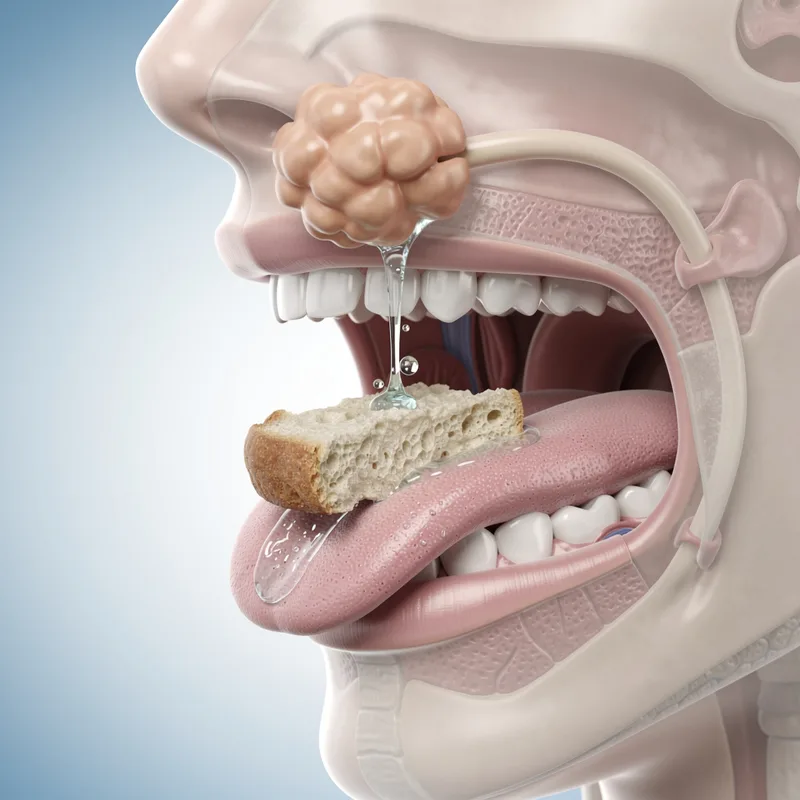
The salivary glands produce saliva, which helps break down food in the mouth.
-
The salivary glands are essential for digestion as they secrete enzymes that initiate the digestive process.
Surface Forms
Morphology
The meaning 'a gland that produces saliva' is directly and transparently derived from combining 'salivary' (connected to saliva production) with 'gland' (an organ that releases fluids). This adjective+noun compositional pattern is common in English and cross-linguistically so, making the MWE immediately understandable to a B1 learner who knows both constituents.
Etymology
Salivary gland comes from the words saliva, the wet 'spit' in your mouth, and gland, a small part of the body that makes and gives out a liquid. So a salivary gland is literally a small part that produces saliva to help you eat, swallow, and start digestion.