

sublingual gland
- noun
- /ˌsʌblɪŋɡwəl ɡlænd/
- Specialized
- In the human body, the sublingual gland is located beneath the tongue and contributes to saliva production.
Examples
-
Sublingual glands, a pair of almond-shaped structures also located below the floor of the mouth, produce secretions much like those of the submandibular glands.
Academic text (2004) -
In some cases, only the ranula itself is removed; in other cases, both the lesion and the sublingual gland are removed via an intraoral approach.
Academic text (2003) -
These findings suggested a mass in the sublingual gland but did not rule out a ranula.
Academic text (2008) -
The most common pitfall during excision is a failure to remove the sublingual gland completely; such a failure increases the risk of recurrence.
Academic text (2003) -
Other documented sites of involvement include the soft and hard palates, the mental regions in the oral cavity, and the gingival, mandibular, and sublingual glands.
Academic text (2006) -
The most common complication of surgery in the latter case is a failure to excise the sublingual gland completely, which results in the presence of residual gland tissue and increases the risk of recurrence.
Academic text (2003) -
Excision of both the ranula and the sublingual gland via an intraoral approach has been recommended, but we believe that complete extirpation of the sublingual gland is unnecessary.
Academic text (2003) -
Excision of both the ranula and the sublingual gland via an intraoral approach has been recommended, but we believe that complete extirpation of the sublingual gland is unnecessary.
Academic text (2003) -
The sublingual gland produces mucin, which is an important component of saliva.
-
During the surgery, the doctor carefully examined the patient's sublingual gland for any abnormalities.
Synonyms
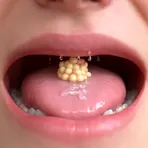
A small part under the tongue that makes saliva to keep the mouth moist
Surface Forms
Morphology
The meaning is directly and transparently derived from 'sublingual' (under the tongue) + 'gland' (an organ that releases fluids), so a learner who knows both constituents can infer it denotes a gland located beneath the tongue that produces saliva. This adjective+noun compositional pattern is regular and cross-linguistically common, making the phrase accessible to learners familiar with the component words.
Etymology
The term sublingual gland comes from Latin parts: sub meaning 'under' and lingual meaning 'tongue'. So it simply names the small gland that makes saliva and sits under the tongue.

