
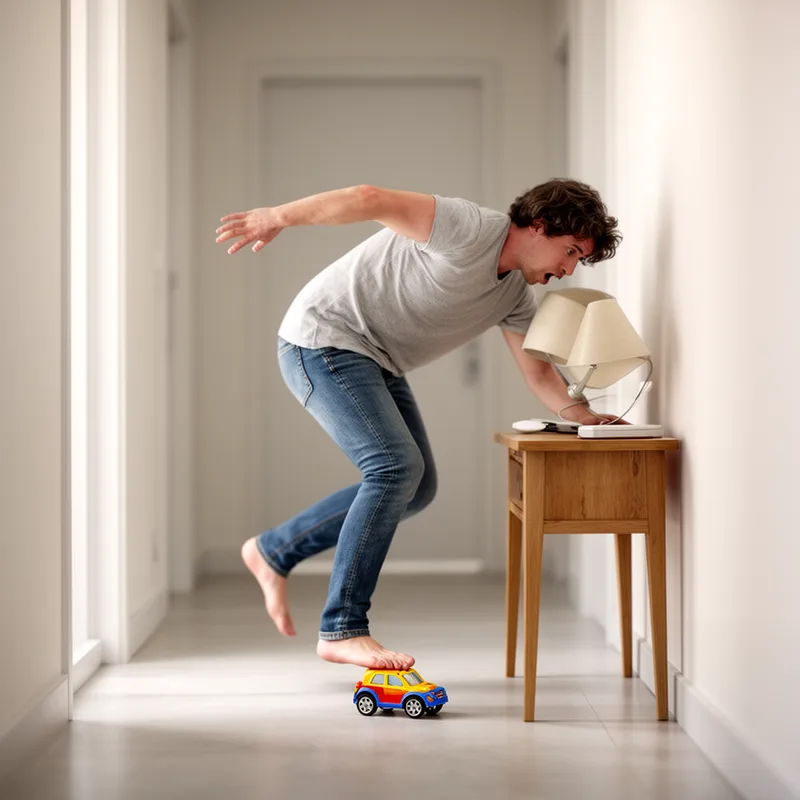
to stumble against


 1
3.5
1
3.5
- phrasal verb
- /ˈstʌmbl əˈɡɛnst/
- He stumbled against the edge of the rug and nearly fell over.
- stumbled against a table
Examples
-
Getting up from his desk, he stumbled against the side of his chair.
Fiction book (2002) -
Not looking where he was going, he stumbled against one of the rose bushes.
Fiction book (2000) -
I stumbled against a table.
Fiction book (2002) -
Slim gets up to help her, but he stumbles against the hatch, which pops open.
Academic text (2009) -
Crawling on the malodorous floor, I stumbled against a piece of hard metal.
Fiction book (1990) -
Andy stumbles against the man in front of him, almost dragging him down.
Fiction book (1994) -
McCaleb stumbles against the bulkhead, then takes off.
Fiction book (2002) -
He hurtled through and stumbled against the crates and barrels on the other side.
Fiction book (1992) -
Rialt steadied Mevita; she stumbled against him at the sight of the endless dark below.
Fiction book (1992) -
He felt his way through the doorway, banged his shin, and stumbled against the steps.
Fiction book (1992)
Synonyms
 111
1.0
111
1.0
To hit something by accident and cause a jolt
 75
2.3
75
2.3
Hit something by accident while moving
 49
1.9
49
1.9
Lose your balance when your foot hits or catches on something while walking
 18
2.1
18
2.1
To hit someone or something by accident while moving
 5
4.1
5
4.1
Lose your balance and fall on wet or muddy ground
 3
2.7
3
2.7
Hit something by accident when you move and touch it
Antonyms

How Forceful
481
2.2
 38
3.7
18
2.1
1
3.5
15
3.1
38
3.7
18
2.1
1
3.5
15
3.1
Surface Forms
Morphology
stumble + against
The meaning 'to trip or bump into something by accident' is directly and transparently derived from combining 'stumble' (to lose balance or trip) with 'against' (indicating contact or collision). This verb + preposition composition is a common, predictable pattern in English (and cross-linguistically), so a B1 learner who knows both words can infer the MWE meaning.
Etymology
Stumble against comes from a clear picture: a person loses their balance and stumbles into or hits something, and the word against shows that contact. So, it means 'to trip or bump into something by accident'.