
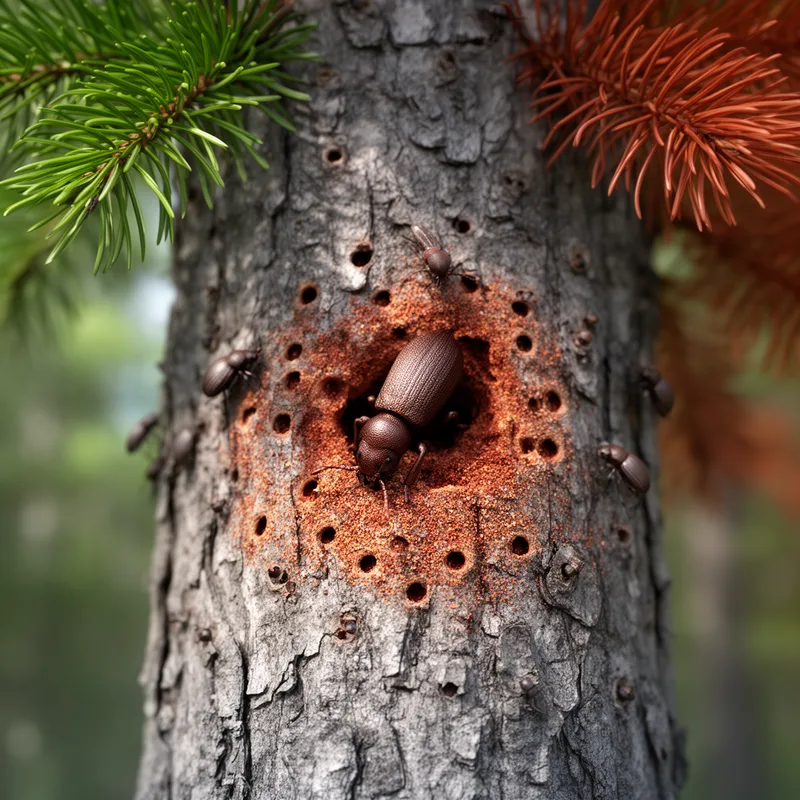
spruce bark beetle
- noun
- /spruːs bɑrk ˈbiːtəl/
- Specialized
- Many spruce bark beetles infest trees in the region.
Examples
-
Foresters are trying new strategies to control the spread of the spruce bark beetle.
-
The population of spruce bark beetles has increased dramatically due to warmer temperatures.
-
Infected trees show signs of spruce bark beetle infestation under their bark.
-
The spruce bark beetle is a major pest for forests.
-
The spruce bark beetle damages trees by boring into the bark and feeding on the cambium.
-
During the summer, the spruce bark beetle populations can explode, causing widespread tree death.
-
Parking close to areas infested by the spruce bark beetle can be detrimental to healthy trees nearby.
Synonyms

 3
8.1
3
8.1

An insect or larva that makes holes in wood and damages trees
 1
6.5
1
6.5
A small beetle that bores tunnels in tree bark and often kills the tree
A small beetle that bores into spruce bark and eats the layer under it, often killing the tree

Small beetles that live under the bark of pine or fir trees and kill grown trees

A small beetle that lives under tree bark and often damages trees
An insect or small animal like a beetle that makes holes in wood and damages it
Surface Forms
Morphology
The compound is transparently composed from its parts: 'spruce' (a type of tree) + 'bark' (tree outer covering) + 'beetle' (an insect), so a learner can infer it refers to a beetle associated with the bark of spruce trees. This noun-noun-noun construction is highly compositional and cross-linguistically parallel, making the meaning predictable to a B1 learner who knows the constituents.
Etymology
Spruce bark beetle names a small beetle that lives under the bark of spruce trees and eats the soft layer there, making tunnels. Because these tunnels stop the tree from getting water and food, the beetles can 'kill' the tree, so the name refers to a pest that bores into and destroys spruce trees.