
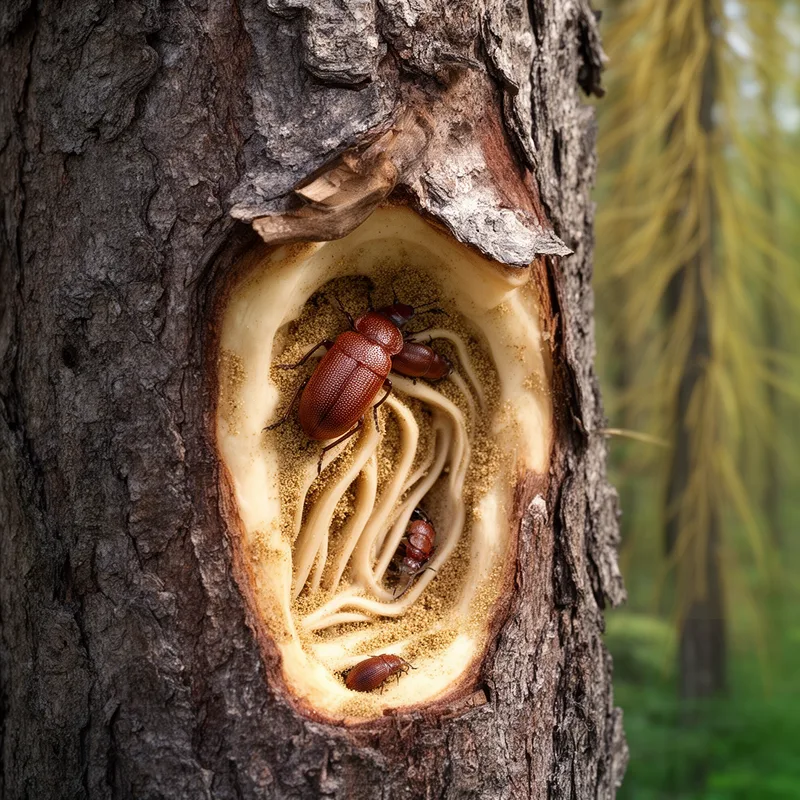
Dendroctonus rufipennis
- noun
- Specialized
- Researchers are studying how Dendroctonus rufipennis spreads and kills its host trees.
Examples
-
The outbreak of Dendroctonus rufipennis in Alaska forests has devastated large areas of spruce trees.
-
Infestations of Dendroctonus rufipennis can result in significant economic losses for the timber industry.
-
The Dendroctonus rufipennis is a significant pest in North America.
-
Many forests have been devastated by the Dendroctonus rufipennis outbreak.
-
Infestations of Dendroctonus rufipennis can lead to the destruction of entire spruce forests.
-
The tiny Dendroctonus rufipennis is responsible for extensive damage to spruce trees in the region.
-
Agricultural experts warn that Dendroctonus rufipennis populations are increasing, posing a threat to local timber resources.
Synonyms

 3
8.1
3
8.1

An insect or larva that makes holes in wood and damages trees
 1
6.5
1
6.5
A small beetle that bores tunnels in tree bark and often kills the tree
A small insect that makes holes in the bark of spruce trees and often kills them

Small beetles that live under the bark of pine or fir trees and kill grown trees
An insect or small animal like a beetle that makes holes in wood and damages it
Surface Forms
Morphology
Dendroctonus + rufipennis
This is a Latin binomial scientific name composed of taxonomic elements rather than ordinary English words; B1 learners will not generally know Latin morphemes or the genus/species conventions. One constituent ('rufipennis') has no dictionary entry here and the compound does not transparently convey 'spruce bark beetle' from its parts, so the meaning is not derivable by a learner who only knows the listed constituents.
Etymology
Dendroctonus rufipennis comes from old Greek and Latin words: dendro- means 'tree', -ctonus means 'killer', and rufipennis means 'red-winged'. The name creates the image of a 'red-winged tree killer', which fits a small beetle that makes holes in spruce bark and often kills the tree.