

to spread out
 89
2.8
89
2.8

- phrasal verb
- /sprɛd aʊt/
- Spread out, but stay in this area.
- spread out over a large area
- were spread out
- spread out in four
Loading YouTube…
Watch on YouTubeSo maybe the people who are spread out among the land as well.
- So maybe the people who are spread out among the land as well.
- Linda In Inksab's story, it began to spread out from the streets.
- And it has this explosive effect that that spreads out across the world.
- And so people think, well, let's spread out and go to Mars.
- He's got mad air conditioning, people spread out but still packed and these lights.
Examples
-
His companions nodded, and on a hand signal from Black, they spread out into the building.
Fiction book (1994) -
All right, spread out, everybody.
-
And we're outside and, you know, we're spread out and it works fine.
-
After he died, his organization spread out, became more of a network.
-
Offering lower prices at non-peak periods may help to spread out customers over the year.
Academic text (1990) -
Pai families, especially in the summer, spread out across a large, rugged area.
Academic text (1998) -
A survey consists of thousands of geophone arrays spread out over several square miles.
Academic text (2001) -
Ground forces have occupied several buildings along Marehan Road... ...but they're all spread out.
-
The cut-up red tiles and white tile dust are spread out across the kitchen counter.
Fiction book (1994) -
The hikers were advised to spread out so that they could cover more ground and find the best trail.
Synonyms
 110
2.7
110
2.7
To make people or animals move quickly in different directions
 104
4.4
104
4.4
To cause people and things, like a crowd or fog, to spread over a wide area
 48
6.8
48
6.8
To make something spread out and disappear, for example fog or tension
 30
3.7
30
3.7
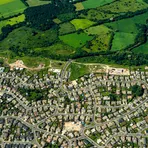
To spread out from one point in different directions
 27
4.6
27
4.6
To spread out over a large area in an untidy way
 8
6.4
8
6.4
To move slowly and get separated from the main group

To move outward in many directions to cover a wide area

To spread apart from a common point like fingers or branches
Antonyms

How Wide

Surface Forms
Morphology
The meaning 'to turn something outward from the center line' is directly derivable from combining 'spread' (to distribute or extend across a surface) with the directional particle 'out' (away from the interior). This motion/extension pattern is a common, compositional phrasal-verb structure found across languages, so a B1 learner who knows both constituents will readily infer the meaning.
Etymology
Spread out has the image of people or things moving away from a center, as when a search team spreads out across a field. So it means 'to move apart' or 'to disperse'.