

to disperse
 104
4.4
104
4.4

- verb
- /dɪsˈpɜrs/
- Until the 1950s, the economy was characterized by small, dispersed land ownership and sheep herding.
- widely dispersed
- geographically dispersed
- disperse oil
Loading YouTube…
Watch on YouTubeLike, that's how it, like, that's how it dispersed through the world was through my tweet.
- Like, that's how it, like, that's how it dispersed through the world was through my tweet.
- Parks will remain open for exercise, but gatherings will be dispersed.
- A shot was fired, probably by a British officer trying to disperse the crowd, and the riot turned deadly.
- Now this part of magnesium oxide smoke will disperse itself.
- Describes how things disperse, disperse away from from their source.
- So for Silicon Valley of where you could actually disperse your things in a useful way.
Examples
-
After the fireworks, the crowd began to disperse and head home.
-
Good people, please disperse.
-
Events have effects that disperse over space and time, right?
-
It's a great way to disperse the negative energy that might want to go around.
-
Put down your weapons and disperse immediately, or face arrest.
-
Please disperse and move back!
-
You have two minutes to disperse.
-
You're ordered to disperse and return to your homes.
-
They also feed on fruit and they disperse the seeds of these fruits.
-
A glance in her direction, and the crowd then dispersed to take up individual concerns.
Fiction book (1990)
Synonyms
 750
1.6
750
1.6
To become known by many people
 152
3.4
152
3.4
Make a group of people leave or spread out
 110
2.7
110
2.7
To make people or animals move quickly in different directions
 103
3.9
103
3.9
To spread information or documents among people
 100
1.1
100
1.1
To put small drops of liquid or tiny pieces on something
 89
2.8
89
2.8
To move apart and cover a wider area
 87
2.0
87
2.0
Give things to several people or places
 81
3.0
81
3.0
To make news or information known to many people
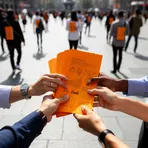 48
6.8
48
6.8
To spread information or ideas widely so many people know them
 48
6.8
48
6.8
To make something spread out and disappear, for example fog or tension
 40
5.5
40
5.5
To spread out and reach many people or places
 23
5.9
23
5.9
Spread ideas, news, or feelings to many people
 4
2.0
4
2.0
Make information spread among many people
Antonyms


How Wide

Surface Forms
Morphology
disperse = sparse (semi-transparent) = dis + sperse
The prefix 'dis-' signals separation and the stem relates to the notion of being scattered (cf. 'sparse'), but 'sperse' is not a standalone modern English word, so learners can only partially infer the meaning from the parts.
Etymology
The word disperse comes from the Latin parts dis- ('apart') and spargere ('to scatter'). Think of someone scattering seeds so they move apart, which is why disperse means to spread out or break up a crowd, fog, or group.