

spiny lobster


 1
4.2
1
4.2
- noun
- /ˈspaɪni ˈlɒbstər/
- The subsequent opening of markets, first in Japan and then in the newly industrializing countries of East and Southeast Asia, has maintained pressure on world spiny-lobster stocks, and most are now at maximum levels of exploitation or are even subject to overexploitation.
- spiny lobster fishery
- catch of spiny lobsters
Examples
-
After the initial research cruises documented lobster concentrations in the NWHI in 1976, research focused on the biology of the spiny lobster Panulirus marginatus.
Academic text (1993) -
Laysan Island, with its associated bank, is a designated reserve for the spiny lobster, Panulirus marginatus, and had no prior history of slipper lobster exploitation.
Academic text (1990) -
As required by law, the vessel kept daily catch and effort logs for spiny lobster.
Academic text (1990) -
In a world of convergent economic systems, the Cuban spiny-lobster fishery is an interesting and important demonstration of an alternative method.
Academic text (1997) -
The modern period in the development of spiny-lobster fisheries dates from the late 1940s, when demand increased in the United States for frozen lobster tails.
Academic text (1997) -
Also in the 1980s, the Northwestern Hawaiian Islands spiny lobster fishery began to bloom.
Academic text (1993) -
Between 1970 and 1989, the harvest of oysters dropped by 44 percent and landings of spiny lobster declined by 34 percent.
Academic text (1993) -
Fishery catch totals for spiny lobster were equal to or greater than those of slipper lobster during 1985-88.
Academic text (1990) -
Who wouldn't enjoy sitting down to a seafood dinner of fresh spiny lobster?
-
The reefs and ocean floor revealed spiny lobsters, spotted eagle rays, and other exotic sea life.
Synonyms
 8
9.3
8
9.3
A large spiny sea animal like a lobster that people eat
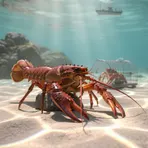 2
2.8
2
2.8
A large sea animal like a lobster with a spiny shell that people eat
 1
3.8
1
3.8
A large sea animal with a spiny shell and no big claws eaten as food
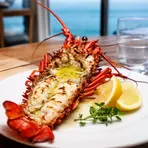
A large spiny lobster without big claws that people eat
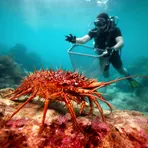
A large sea animal with a spiny shell you can eat and no big claws
Surface Forms
Morphology
The phrase is a straightforward adjective+noun composition: 'spiny' (having sharp points) modifies 'lobster' (a crustacean), so a B1 learner who knows both words will understand it refers to a lobster with spines. The technical detail that spiny lobsters lack large claws is specialized biological knowledge but does not prevent the basic, compositional meaning being immediately derivable.
Etymology
The name spiny lobster comes from the animal being a lobster with many sharp spines instead of big claws. That's why spiny lobster today means a warm-water 'sea animal' with a spiny shell and 'no large claws'.