

spectroscopy
 5
7.7
5
7.7

- noun
- /spɛkˈtrɒskəpi/
- Specialized
- Another important capability of 2D spectroscopy is its ability to overcome inhomogeneous broadening.
- 2D spectroscopy
- atomic spectroscopy
- optical spectroscopy
Loading YouTube…
Watch on YouTubeThis is the first of two lectures on spectroscopy and dynamics.
- This is the first of two lectures on spectroscopy and dynamics.
- And, and Draper like to say that spectroscopy had made the chemist's arms millions of miles long.
- The standard trick of of course, spectroscopy, but and using the Hubble law.
- So this is, this is the secret of spectroscopy, absorption line spectroscopy.
- But I think the transformational science is in the what we call spectroscopy.
- And we do that with a spectroscopy that works very similar to the mass spectrometer in all the TV shows.
Examples
-
There are also plans for a workshop on infrared spectroscopy after the main symposium.
Academic text (1990) -
Heavy metal concentrations were determined using atomic absorption spectroscopy with a graphite furnace (AAnalyst 800, PerkinElmer; Waltham, MA).
Academic text (2015) -
Where else would I get an opportunity to conduct a spectroscopy project?
Academic text (1993) -
What is the difference between emission spectroscopy and absorption spectroscopy?
Academic text (2008) -
The field of rare earth spectroscopy has been rejuvenated by the demand for novel fiber devices.
Academic text (1993) -
This technique of spectroscopy was pioneered in part by this astronomer, Lady Margaret Huggins.
-
Nonetheless, even unstable spectra find many applications, such as imaging and spectroscopy, in which time-averaged measurements are important.
Academic text (2012) -
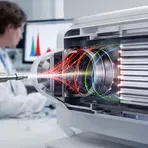
Optical two-dimensional spectroscopy uses a sequence of laser pulses that are incident on the sample from different directions.
Academic text (2012) -
Lasers have revolutionized spectroscopy, and they have given birth to the new field of nonlinear optics.
Academic text (1993) -
Using a spectroscope, researchers can analyze the composition of stars and planets through their light spectra, which is a key aspect of spectroscopy.
Synonyms
 2
7.5
2
7.5
A way to measure light or particles to learn what a material is made of
 1
7.5
1
7.5
A method that uses light patterns to find what a material is made of
 1
5.6
1
5.6
To study light from an object to find what it is made of
 1
7.2
1
7.2
A method to find what a material is made of by studying light it emits or absorbs
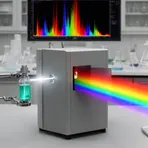
A method that records light to study what things are made of

The study of light and other radiation to learn what they contain
Compounds

- Specialized
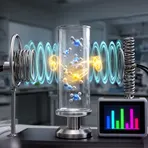
A method that uses radio waves to measure energy changes in atoms or molecules
How Small
- Specialized

- Specialized
5
7.7
Surface Forms
Morphology
spectroscopy = spectrum (semi-transparent) = spectro + scopy
The word literally means the study/observation of spectra, which is derivable from 'spectrum' + the technical suffix '-scopy', but the combining form 'spectro-' and the suffix are technical and may be unfamiliar to learners.
Etymology
Spectroscopy comes from spectro- meaning 'appearance', as in spectrum the band of colors, and -scopy meaning 'to look', as in scope and microscope. So, spectroscopy is literally 'looking at a spectrum', which is why scientists study the light or colors of a substance to learn what it is.