
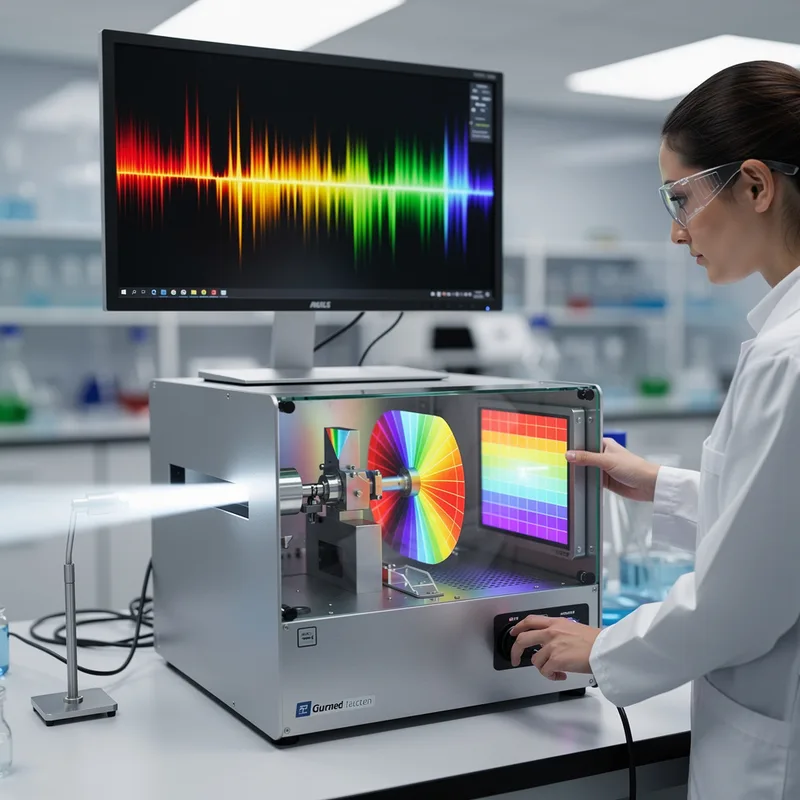
spectrograph
 4
8.9
4
8.9

- noun
- /ˈspɛktrəˌgræf/
- Specialized
- Last year, Queloz and company installed their new high-precision spectrograph, called HARPS, on the European Southern Observatory's 3.6-m telescope in the Chilean Andes.
- CCD spectrograph
- high-quality spectrograph
- telescope spectrographs
Loading YouTube…
Watch on YouTubeBut then Roman will also have a spectrograph on board which will get you a spectrum through each of those galaxies.
- But then Roman will also have a spectrograph on board which will get you a spectrum through each of those galaxies.
- We we do it with a spectrograph, so basically a prism.
- OK, Focus, Focus, we must talk dark matter nothing using an optical spectrograph designed by Henry Ford.
Examples
-
Another group has been studying quasar spectra from Hubble's Faint Object Spectrograph.
Academic text (1995) -
Now, this flash, later analyzed in a spectrograph, gives us exact information about the components of the explosion.
-
More surprising, though, is what the spectrograph picked up.
-
The imaging spectrograph is connected to a computer.
Academic text (2002) -
An infrared camera and spectrograph, and modern control and guiding equipment are under construction and testing.
Academic text (1994) -
Next to the telescope itself, the spectrograph has proven to be the most important tool in the astronomer's kit.
Academic text (2004) -
Campbell designed a superior spectrograph that would be rigid and temperature-controlled.
Academic text (1992) -
The imaging spectrograph scans a moving apple hundreds of times, each time sensing a line across the apple's surface.
Academic text (2002) -
The resolution of the general-purpose telescope spectrographs used by the other planet hunters is limited to about 3 m/s.
Academic text (2004) -
The spectrograph revealed new details about the star's composition during the analysis.
Synonyms
 13
7.2
13
7.2
A machine that measures light or separates charged particles to identify substances
 1
8.4
1
8.4
A tool that splits light into colours for study
 1
9.9
1
9.9
A machine that measures how much light of different colors a substance absorbs to help know what it is
An instrument that uses a prism to split light into separate colors for study

A device that measures how much light there is at each color

A machine that takes pictures of the Sun using one color of light to show details

A machine that shows different pitches in a sound as a picture
Compounds

- Specialized
A machine that separates tiny charged parts of atoms by mass and shows them on a graph
Surface Forms
Morphology
spectrograph = spectro + graph
The term is built from classical combining forms meaning roughly 'spectrum' plus 'recording device', but the exact scientific instrument sense is specialized and not fully predictable for an average B1 learner.
Etymology
Spectrograph comes from spectrum ('a range of light or colors') and graph ('to write' or 'to record'), the same graph you find in photograph. So a spectrograph is a machine that 'writes down' the light spectrum, which is why scientists use it to study light.