
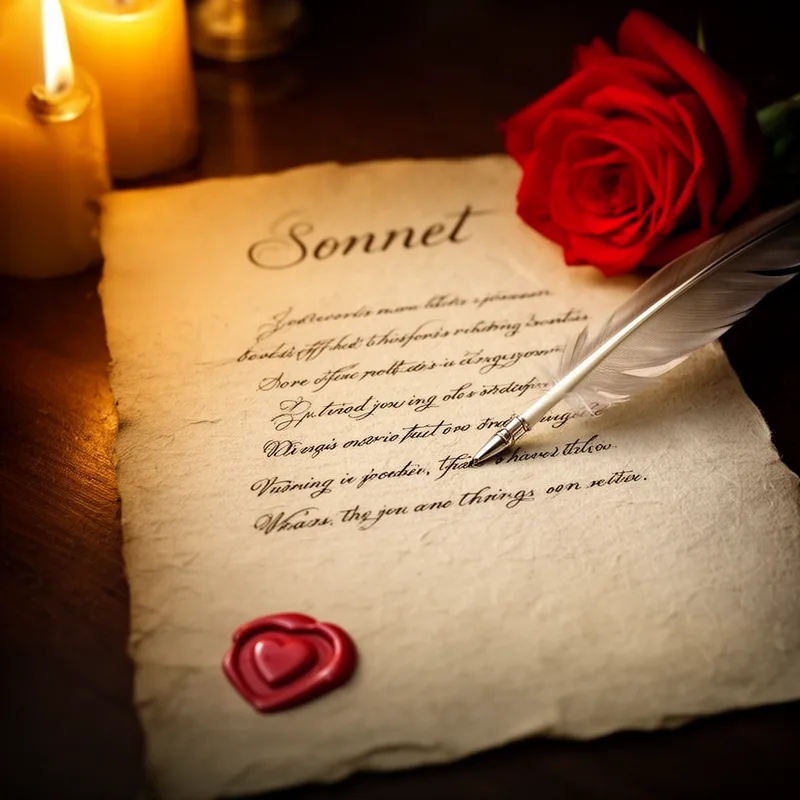
sonnet
 29
6.2
29
6.2

- noun
- /ˈsɑːnɪt/
- Literature
- In her literature class, we studied several classic sonnets from the Renaissance.
- sonnets and elegies
- write sonnets
- final sonnet
Loading YouTube…
Watch on YouTubeSo I he has so many sonnets written for others, I thought I'd try and do the same.
- So I he has so many sonnets written for others, I thought I'd try and do the same.
- And you know, it's not it doesn't have the same cultural prestige as being an expert in Renaissance poetry or, you know, the sonnets of Shakespeare.
- So some of the most difficult formal poems that I've written, say one sentence sonnets in tertsarima, I've been able to do those fairly quickly.
- He's done too much hard time with too many sonnet writers in Harvard Yard.
- In quote elsewhere, McClure notes that the ghost tantras are sonnets.
Examples
-
Shakespeare's Sonnet 116 is an ode to true love:
-
Ms. Mullen's collection includes several sonnets, at least one pantoum, and a couple of sestinas.
Fiction book (1992) -
One normally expects the turn in a Shakespeare sonnet to come in line 9.
Academic text (1999) -
You all did a great job with the sonnets today.
-
I have been reading sonnets.
-
One week she wrote a silly sonnet early in the morning, the next a villanelle.
Fiction book (2002) -
Jane has attempted for thirty years to write one sonnet each fortnight, beginning Monday morning.
Academic text (2013) -
Why, that's from my favorite sonnet by Mrs. Browning.
-
We examine properties that define the sonnet and disregard properties that fall outside of this definition.
Fiction book (1999) -
Jane also has a framed poster of Rainer Maria Rilke's sonnet to Orpheus on the wall.
Academic text (2013)
Synonyms

 1
8.8
1
8.8
A 14-line poem that has three four-line parts and final two lines with the rhyme abab cdcd efef gg
A 14-line poem with three four-line parts and a final two-line part with a regular rhyme pattern

A 14-line poem with three four-line parts and a final two-line rhyme
A 14-line poem with eight lines in one rhyme pattern and six in another
A sonnet with eight lines in the first part and six lines in the second, used by Petrarch
A 14-line poem with eight lines that present a problem and six lines that respond using set rhyme patterns
Compounds
- Literature
1
8.8
A 14-line poem that has three four-line parts and final two lines with the rhyme abab cdcd efef gg
- Literature
A 14-line poem with three four-line parts and a final two-line part with a regular rhyme pattern
- Literature
A 14-line poem with eight lines that present a problem and six lines that respond using set rhyme patterns
- Literature
A 14-line poem with eight lines in one rhyme pattern and six in another
- Literature
A 14-line poem in lines of ten beats with three four-line parts and a final rhymed pair
How Light
- Literature

- Literature
42
4.6
- Literature
29
6.2
- Literature
6
8.1
8
8.2
Surface Forms
Etymology
Sonnet comes from the Italian sonetto, which means 'little song', and from Latin sonus meaning 'sound'. So a sonnet is like a small song—a short poem with a musical rhythm and a fixed form.