
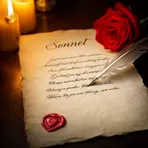
Elizabethan sonnet
- noun
- /ɪˌlɪzəˈbiːθən ˈsɒnɪt/
- Literature
- Students in English class analyzed several Elizabethan sonnets to understand their structure and themes.
Examples
-
Shakespeare pioneered the Elizabethan sonnet, making it famous in English literature.
-
Shakespeare wrote many famous Elizabethan sonnets.
-
She tried to write her own Elizabethan sonnet using the classic rhyme scheme and iambic pentameter.
-
An Elizabethan sonnet consists of fourteen lines.
-
Shakespeare is famous for writing many Elizabethan sonnets that explore themes of love and beauty.
-
An Elizabethan sonnet typically consists of 14 lines arranged in three quatrains followed by a couplet.
-
In her poetry class, she learned how to write an Elizabethan sonnet using the abab cdcd efef gg rhyme scheme.
Synonyms
 29
6.2
29
6.2

A short poem of 14 lines with a set rhyme pattern often about love


 1
8.8
1
8.8
A 14-line poem that has three four-line parts and final two lines with the rhyme abab cdcd efef gg

A 14-line poem with three four-line parts and a final two-line rhyme
Surface Forms
Morphology
The phrase simply combines 'Elizabethan' (of the period of Queen Elizabeth I) with 'sonnet' (a 14-line poem), so a B1 learner who knows both words can infer it denotes a sonnet associated with the Elizabethan era. While the precise technical details (rhyme scheme, metre) are specialist knowledge, the basic categorical meaning is directly derivable from the constituents.
Etymology
Elizabethan sonnet gets its name from the time of Queen Elizabeth I, when poets such as Shakespeare changed the Italian sonnet into an English form made of three quatrains — three groups of four lines — and a final couplet that gives a short 'answer' or twist. That's why an Elizabethan sonnet, often called a 'Shakespearean sonnet', means that specific way the lines are grouped and rhyme.