

to slog
 1
5.3
1
5.3

- verb
- /slɔg/
- After a long day at work, he slogged home, feeling exhausted.
- slog through snow
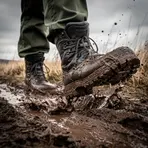
- slog through wet
- slog through knee
Examples
-
We were sick of the city, and we wanted to raise Kevin someplace he could slog through creeks and climb trees and come home with mud in his hair and frogs in his pockets.
-
He slogs through the snow, down a gulley and up the embankment to a barbed-wire fence.
Fiction book (1996) -
They quietly slog toward the road.
Fiction book (2002) -
OK, there we are, slogging through the wetland.
-
Laroche and Orlean slog through the water with purpose, looking only straight ahead.
Fiction book (2002) -
Side by side, Hanover and Pantucci quickly slog their way through waist-high water.
Fiction book (1998) -
Hanover and Pantucci quickly slog their way through knee-high water.
Fiction book (1998) -
Lanky young men in wetsuits slog through shallows and mud.
Fiction book (1999) -
She slogs from tree to tree, letting each one support her downhill-leaning weight for a moment before slogging to the next.
Fiction book (1996) -
We had to slog through the thick mud after the rainstorm.
Synonyms
 ∞
1.0
∞
1.0
To move on foot at a normal speed
 179
2.8
179
2.8
To move slowly and with effort because you are tired
 21
5.5
21
5.5
To walk slowly with heavy steps because you are tired
 17
5.5
17
5.5
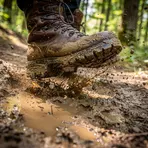
To walk with heavy steps, often over rough ground
 10
6.4
10
6.4
To walk with heavy, steady steps, often when tired
 8
6.3
8
6.3
To walk with heavy noisy steps that make loud sounds
 4
7.5
4
7.5
To walk with heavy, noisy steps that make a loud sound
 4
5.5
4
5.5
To walk slowly with heavy steps because you are tired
 2
5.9
2
5.9
To walk with heavy noisy steps that show effort or anger
 2
4.9
2
4.9
To walk with heavy, clumsy, noisy steps

To walk slowly and with effort over long or difficult ground

To move slowly through wet or muddy ground
Antonyms


How Slow

Surface Forms
Etymology
Slog for walking slowly grew from the same idea of heavy effort, as if each step is a hard push into the ground, so think of moving like a slow, heavy machine. That is why to 'slog' through mud or work is to walk or move with slow, heavy steps because it is difficult and tiring.