

sinusoid
- noun
- /ˈsaɪnəˌsɔɪd/
- Specialized
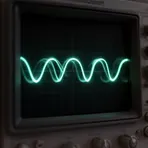
- A sinusoid represents the mathematical function y = sin x, forming a smooth wave pattern.
Loading YouTube…
Watch on YouTubeJust thinking about sinusoids throughout the converter, you don't always get that.
- Just thinking about sinusoids throughout the converter, you don't always get that.
Examples
-
This fluctuation is not sinusoidal but can be represented as a superposition of orthogonal sinusoids at periods of 7 and 3.5 days.
Academic text (1995) -
Further investigation is warranted, in which researchers compare the effects of envelope DRs on speech intelligibility between noise-vocoded and sinusoid-vocoded speech.
Academic text (2013) -
Well, the fast sinusoid here is called the carrier.
-
The peaks due to the two sinusoids are quite apparent, and there is essentially no distortion.
Academic text (1990) -
The signal was a digitally generated 500-Hz sinusoid using a sampling frequency of 25 kHz.
Academic text (1992) -
For our data (2 years), the periodogram fit sinusoids whose periods were integer fractions of 735 days.
Academic text (1995) -
The six chords are composed of the following sinusoids with the respective crest factors (CF): PREFORMATTED TABLE
Academic text (1993) -
There are a large number of distortion products generated by the clipping, with major peaks found in the vicinity of the third and fifth harmonics of the excitation sinusoids.
Academic text (1990) -
To this end, the response of the instrument is measured for an excitation consisting of the 60 dB SPL-shaped noise combined with an 80 dB SPL swept sinusoid.
Academic text (1990) -
While it is obvious that the envelope fluctuations of speech are not reproduced, this test signal does come closer to a speech-like stimulus than the single swept sinusoid specified in the ANSI S3.22 standard (1).
Academic text (1990)
Synonyms
 3
5.1
3
5.1

A smooth repeating wave that goes up and down in a regular curved line


 1
6.8
1
6.8
A smooth wavy graph that repeats regularly, for example y = sin x
Surface Forms
Morphology
sinusoid = sinus (semi-transparent) = sinus + oid
The suffix '-oid' means 'resembling', but the base form 'sinus' (and its relation to the trigonometric 'sine') may not be immediately obvious to general learners.
Etymology
Sinusoid comes from the math word sine, which traces back to Latin sinus 'curve' or 'fold', plus the ending -oid meaning 'like'. So a sinusoid is 'like a sine' — a smooth, wave-shaped curve such as y = sin x.