

sensorineural hearing loss


 1
5.3
1
5.3
- noun
- /ˌsɛn.səˈnʊr.əl ˈhɪr.ɪŋ lɔs/
- Specialized
- Middle ear surgery carries a small risk of sensorineural hearing loss.
- severe sensorineural hearing loss
- profound sensorineural hearing loss
- bilateral sensorineural hearing loss
Examples
-
Repeat audiograms demonstrated fluctuating sensorineural hearing loss in the affected ear.
Academic text (1999) -
The majority of today's hearing aid users suffer from permanent sensorineural hearing loss.
Academic text (1998) -
The initial complaint of the patient described in this paper was bilateral sensorineural hearing loss.
Academic text (1998) -
Moderate to severe, nonprogressive sensorineural hearing loss has also been reported.
Academic text (2004) -
For this experiment, nine subjects with mild to moderately severe sensorineural hearing loss participated.
Academic text (1993) -
Audiometry without the hearing aids documented a profound bilateral sensorineural hearing loss.
Academic text (2005) -
A 50-year-old woman presented with progressive left-sided sensorineural hearing loss, vertigo, pulsatile tinnitus, headaches, and ataxia.
Academic text (2008) -
Meniere syndrome classically involves episodic sensorineural hearing loss, tinnitus, aural fullness, and vertigo.
Academic text (2009) -
The majority of today's hearing aid users suffer from permanent sensorineural hearing loss.
-
Middle ear surgery carries a small risk of sensorineural hearing loss.
Synonyms
 13
2.7
13
2.7
A condition in which you cannot hear well in one or both ears
 11
2.7
11
2.7
A condition in which a person cannot hear well or at all
 1
3.9
1
3.9
Partial or total loss of the ability to hear
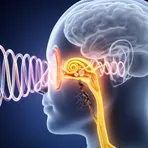
Hearing loss caused by damage to the inner ear or the part that sends sound to the brain
Surface Forms
Morphology
sensorineural + hearing + loss
The adjective 'sensorineural' literally refers to sensory nerves and neural processes, so when combined with 'hearing' and 'loss' the phrase straightforwardly denotes loss of hearing due to nerve/inner-ear (neural) damage. This is a compositional, descriptive medical term that a learner who knows the constituent meanings can derive.
Etymology
Sensorineural hearing loss comes from the parts sensorineural (about the ear's tiny 'sensors' and the 'nerve' that sends sound) and hearing loss, creating a simple picture of those sensors or the nerve being harmed. So the name helps you remember it means losing hearing because of damage in the 'inner ear' or the 'hearing nerve'.