

to ruffle
 7
4.2
7
4.2

- verb
- /ˈrʌfəl/
- A light breeze began to ruffle the leaves on the trees, creating a soft whispering sound.
- a breeze ruffled
- the wind ruffled
- ruffled the water
Loading YouTube…
Watch on YouTubeRestaurant servers, the guy who would cut the lawn even to some of your extended family, but then they'd playfully ruffle your hair and say, how's my kid doing?
- Restaurant servers, the guy who would cut the lawn even to some of your extended family, but then they'd playfully ruffle your hair and say, how's my kid doing?
Examples
-
The wind picked up, causing the ocean to ruffle and form small waves all around us.
-
A damp wind ruffled her clothes as she walked a few steps, then stopped.
Fiction book (1997) -
I felt good out on the balcony, a dry breeze ruffling my hair.
Fiction book (1997) -
The night is quiet except for the ruffled water lapping at the rock-lined shore.
Academic text (1993) -
Everyone sighed, and a warm breeze came up over the pines and ruffled our little lake.
Fiction book (1991) -
The canvas curtain shading the small balcony off her bedroom ruffled in the breeze.
Fiction book (1998) -
The rooster, suddenly indifferent, ruffles his feathers and struts around the house.
Fiction book (1991) -
As she walked through the garden, the playful wind gently ruffled her dress, making it flutter.
Synonyms
 52
3.0
52
3.0
To make something untidy, dirty, or not in the right place
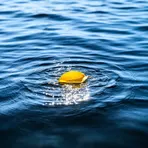 49
2.7
49
2.7
To move in small waves on water when wind blows
 35
3.5
35
3.5
To move quickly and lightly back and forth, like wings or leaves
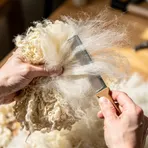 25
6.8
25
6.8
To pull apart and loosen fibers by brushing or combing them
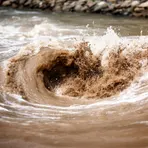 18
8.5
18
8.5
To make water or other liquid move strongly and become cloudy
 10
7.7
10
7.7
To move in smooth waves like tall grass in the wind
 6
5.4
6
5.4
To make clothes or hair wrinkled and messy
 1
7.6
1
7.6
To make small ripples on water by moving it slightly


 1
4.2
1
4.2
To make a smooth surface uneven or wrinkled

To make small folds in cloth by pressing or gathering it

To make a surface form small waves or ripples

To make the edges less smooth by creating small uneven parts

To gather fabric into small folds to make a decorative edge on clothes

To gather small folds in cloth to make a decorative edge
Antonyms

Idioms

Phrasal Verbs
How Uneven

Surface Forms
Morphology
Etymology
Ruffle comes from an old idea of making something 'rough' or uneven, like when wind teases feathers or a hand disturbs water. So to ruffle a surface is to make small waves or ripples and disturb its smoothness.