

to rub off
 21
3.6
21
3.6

- phrasal verb
- /rʌb ɔf/
- And I hope that, you know, maybe some of that will rub off on you as well.
- rub off on his teammates
- luck rubbed off
- attitude rubs off
Loading YouTube…
Watch on YouTubeIt's like just with your hand, you could rub it right off with these.
- It's like just with your hand, you could rub it right off with these.
- It tends to be volatile even when it's been dry for a couple of weeks, it tends to rub off and leave residue.
- It's a no rinse formula and it will kind of stay in your towels, but if you like, rub it off.
- So you want to rub off your makeup when it's dry.
- And that's really rubbed off on us.
- Their Stardust and positivity and courage and integrity will rub off on you.
- She was an advocate for mental health, being sober, sobriety and that sort of rubbed off on me, but only just now.
- You know, I, I feel like maybe it's my lack of hardscape knowledge probably that's rubbing off on that decision.
Examples
-
His wife's family must be rubbing off in some mysterious, unpleasant way.
Fiction book (1992) -
I model a love for learning in the classroom and hope that it rubs off.
Academic text (2005) -
Maybe some of your magic rub off on me.
-
We know that belief systems rub off on people around us.
-
I want some of that goodness to rub off on me
-
And I think that a lot of his experience rubbed off on me, that he, he came from a place where he had no rights.
-
Leia's diplomatic patience must be starting to rub off on him.
Fiction book (1991) -
I think your knack for dream interpretation may have rubbed off on me a little.
Blog text (24) -
She was an advocate for mental health, being sober, sobriety and that sort of rubbed off on me, but only just now.
-
The artist hopes that his dedication will rub off on his students over time.
Synonyms
 35
5.8
35
5.8
To have a mood or behaviour spread from one person to others
 31
1.0
31
1.0
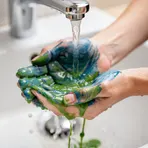
To remove something from a surface by washing with water or soap
 20
1.0
20
1.0
Remove dirt or marks from a surface by rubbing with a cloth
 1
3.4
1
3.4
Remove a mark by moving a cloth or hand over it many times
Antonyms

Surface Forms
Morphology
The literal sense ('to remove something by rubbing') is directly and transparently derived from 'rub' (apply repeated motion) + 'off' (away from a surface). The figurative sense (a quality or habit transferring to another) is a motivated metaphorical extension of the literal meaning and is somewhat inferable but not fully predictable without exposure, so overall the item is best classified as semi-transparent.
Etymology
The verb rub off comes from the image of rub and off, where rubbing two things makes colour, dirt, or even a mood move from one to the other. That's why we say a habit or mood 'rubs off' on someone, meaning it 'transfers' or 'influences' them.