

repellency
- noun
- /rɪˈpɛlənsi/
- PHOTO (COLOR): Entomologist Jian Chen checks the repellency of specific compounds using a new bioassay he developed based on the digging behavior of fire ants.
- water repellency
- bird repellency
Examples
-
This is explained by the incidence of water repellency under the tree canopy.
Academic text (2002) -
Bird repellency of biopesticides
Academic text (2011) -
The bird repellency of registered pesticides
Academic text (2011) -
Some studies have associated the amount of water repellency with particular vegetation types, such as certain evergreen species, in dry conditions (Doerr, Shakesby, and Walsh 2000).
Academic text (2002) -
Other research has shed light on water-repellency mechanisms in different environmental conditions (see, for example, DeBano 2000; Doerr, Shakesby, and Walsh 2000).
Academic text (2002) -
For example, Eisemann and colleagues (2011) estimated that it costs about $8 million to register a new agricultural pesticide compared with about $1 million to supplement a registered pesticide for an additional use (e.g., bird repellency).
Academic text (2011) -
Keywords: soil water repellency, groundwater recharge, grassland plantation, numerical modeling, infiltration test, Halsey Forest.
Academic text (2017) -
Relatively few of those compounds, however, showed evidence of repellency and so underwent further testing through replicated cage tests or field trials (Avery 2002, Avery and Cummings 2003).
Academic text (2011) -
The jacket's special coating provides excellent repellency against rain and snow.
-
Good quality tents should have high repellency to keep occupants dry during heavy downpours.
Synonyms

 1
8.7
1
8.7

A state of not allowing water, light, or ideas to pass through


 1
8.6
1
8.6
A tendency to push water away rather than soak it in
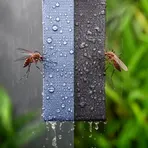
A property of a material that keeps water and insects away
Antonyms

- NSFW
19
3.2
The quality that makes people notice and like someone's looks or character
How Resistant

Surface Forms
Morphology
repellency = repellent (transparent) = repell + ency
Formed from the adjective 'repellent' with the productive noun-forming suffix '-ency', so the meaning 'quality or ability to repel' is directly derivable.
Etymology
Repellency comes from the parts re- 'back' and pellere 'to push', the same root you see in repel and propel. So repellency is the ability of a material to 'push away' things like water or insects.