
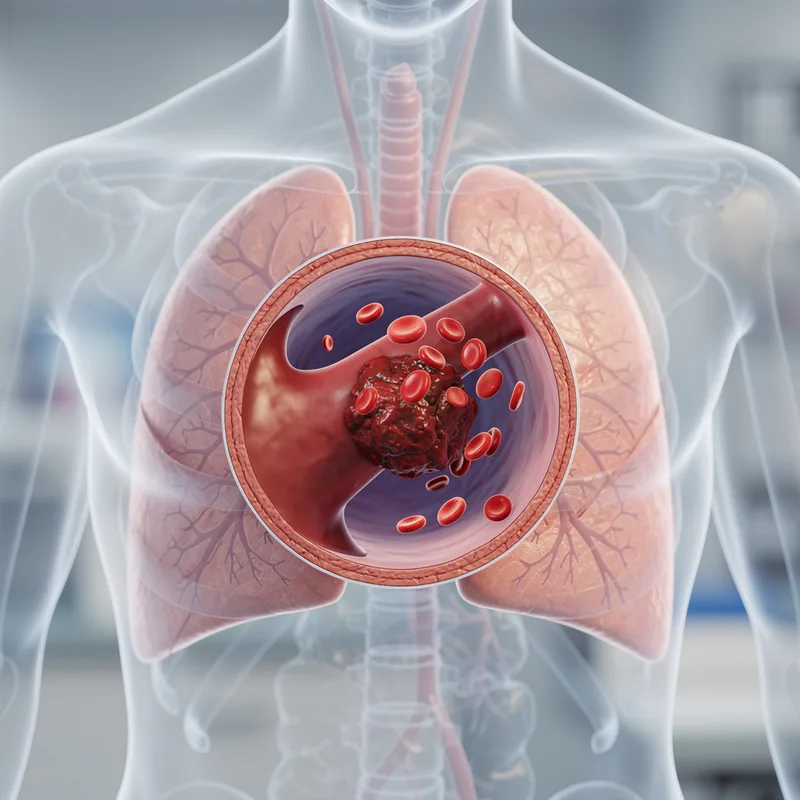
pulmonary embolism
 6
6.1
6
6.1

- noun
- /ˈpʌlməˌnɛri ˌɛmbəˈlɪzəm/
- Specialized
- The doctor confirmed that her sudden breathing difficulties were caused by a pulmonary embolism.
- acute pulmonary embolism
- symptomatic pulmonary embolism
- diagnosis of pulmonary embolism
Loading YouTube…
Watch on YouTubeBut hey, I had a pulmonary embolism, which means a piece of blood clot broke off and went to my lungs.
- But hey, I had a pulmonary embolism, which means a piece of blood clot broke off and went to my lungs.
Examples
-
Several months later, the patient was admitted with a pulmonary embolism, and a V/Q scan showed no perfusion of the right lung.
Academic text (1992) -
Haemoptysis may be caused by cancer, tuberculosis, and pulmonary embolism, among other conditions.
Academic text (2012) -
There was no evidence of pulmonary embolism.
Academic text (2007) -
Today I have my medical report confirming that I am negative for pulmonary embolism.
Blog text (12) -
Imaging plays a key role in the diagnosis of pulmonary embolism.
Academic text (2007) -
But hey, I had a pulmonary embolism, which means a piece of blood clot broke off and went to my lungs.
-
An inferior caval filter can also be used in preventing pulmonary embolism.
Academic text (2006) -
Deep vein thrombosis (DVT) and pulmonary embolism (PE) are important complications to recognize and help prevent.
Academic text (2007) -
Indications for use include deep vein thrombosis (DVT), pulmonary embolism (PE), AF, and following the fitting of a mechanical heart valve.
Academic text (2012) -
After being diagnosed with a pulmonary embolism, he was immediately started on blood thinners.
Synonyms
 17
8.1
17
8.1
A sudden blockage in a blood vessel by a clot or air bubble carried in the blood

A blood vessel blocked by a piece of a blood clot that moved from another part of the body
Surface Forms
Morphology
The compound combines 'pulmonary' (relating to the lungs) and 'embolism' (an occlusion of a blood vessel by an embolus), so the meaning—an embolic blockage in the lung/pulmonary circulation—is directly inferable from the parts. This is a straightforward medical compound found cross-linguistically, so a learner who knows both constituents can reliably derive the MWE meaning.
Etymology
Pulmonary embolism comes from two parts: pulmonary meaning 'lung' and embolism meaning a 'plug' or 'stopper'. The image is a blood clot that travels from another part of the body and acts like a plug in a blood vessel of the lung, so the term means a dangerous blockage in the lungs that can cause shortness of breath.