

protozoan
 2
7.9
2
7.9

- noun
- /ˌproʊtəˈzoʊən/
- Specialized
- Unlike these other protozoans, however, L. clarki is far from defenseless.
- protozoan parasite
- protozoan infection
- parasitic protozoans
Examples
-
Chagas disease is caused by the protozoan parasite Trypanosoma cruzi, and insect members of the subfamily Triatominae are intermediate hosts.
Academic text (2016) -
In tropical regions, certain protozoans can cause diseases in humans and animals.
-
The spore-forming protozoan has been studied for years, but much remains to be learned about it.
Academic text (2005) -
Cyclospora is a protozoan parasite that causes infections in the summer.
Academic text (2012) -
The result: 85 to 90 percent of the colonies died after being infected with the biocontrol protozoan.
Academic text (1994) -
Toxoplasmosis is a protozoan infection caused by the parasite Toxoplasma gondii.
Academic text (2006) -
Human babesiosis is an emerging tick-borne disease caused by the intraerythrocytic protozoan Babesia microti.
Academic text (2014) -
The scientist studied the protozoan under a microscope to understand its structure.
-
In the food chain, protozoans serve as an important food source for larger organisms.
Synonyms
 1
7.6
1
7.6
A tiny organism made of one cell that moves and eats small living things like an amoeba

A single-celled living thing usually too small to see without a microscope

A tiny living creature that you can see only with a microscope, like an amoeba

A very small single-celled creature that you can see with a microscope, like an amoeba
Compounds

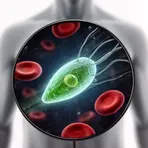
- Specialized
A single-cell creature that moves with tail-like parts and can cause disease in people

- Specialized
A one-celled organism that moves with whip-like tails and can cause disease in animals or people
Surface Forms
Etymology
The word protozoan comes from proto- 'first' and zoon 'animal', so it literally means 'first animal'. That's why a protozoan is a very small, single-celled 'animal', a simple creature often seen under a microscope.