
protozoa
 1
7.6
1
7.6

- noun
- /ˌproʊtəˈzoʊə/
- Specialized
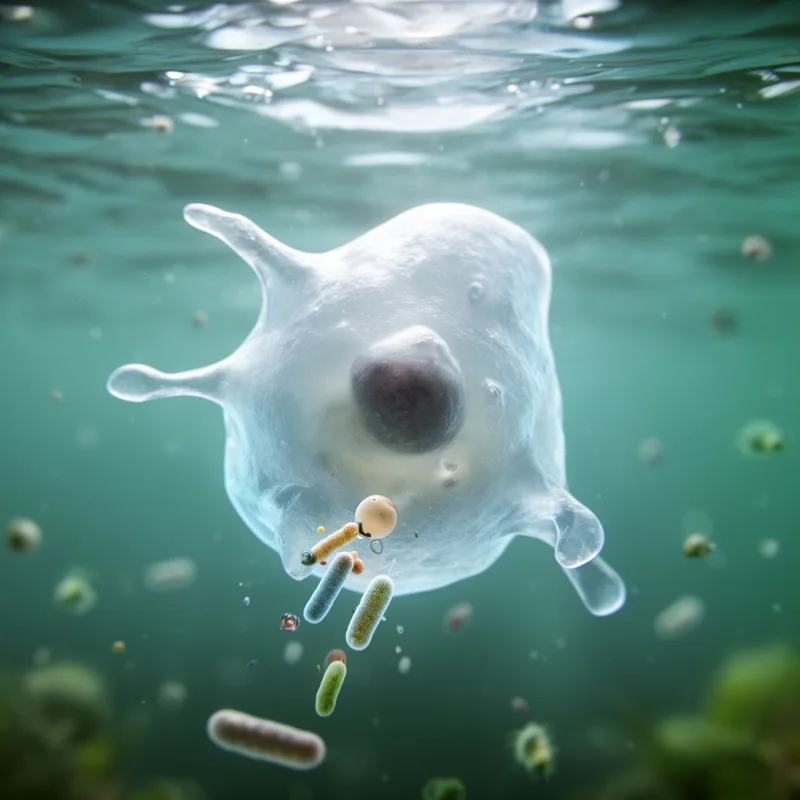
- When I was a student and first saw, through a microscope, one-celled protozoa moving across my field of vision, I marveled at how fast they traveled.
- bacteria and protozoa
- fungi and protozoa
- protozoa and viruses
Examples
-
Pesticides easily find their way into soils, where they may be toxic to arthropods, earthworms, fungi, bacteria, and protozoa.
Academic text (1992) -
Microscopic protozoa like Amoeba and Paramecium can move using their specialized structures.
-
"Amoebae and protozoa are what I studied in biology.
Fiction book (2001) -
The image of those microscopic protozoa zipping around at an incredible rate was an optical illusion.
Academic text (2006) -
And it may be essential to sustain extant life-forms, as suggested by experiments with protozoa and bacteria.
Academic text (1999) -
Food is a vehicle for the transmission of numerous infectious diseases caused by bacteria, viruses, protozoa, and helminth parasites.
Academic text (2006) -
The most common foodborne parasites are protozoa, roundworms, and tapeworms.
Blog text (22) -
Most individuals in such a habitat are physiologically active, and other soil invertebrates, protozoa, tardigrades, and rotifers are present.
Academic text (1999) -
Bacteria and Archaea mingle with other microbes like algae, fungi, and protozoa, forming dense, organized structures that grow on almost any surface.
-
Scientists study protozoa to understand their role in ecosystems and the food chain.
Surface Forms
Morphology
protozoa = proto + zoa
This is a learned scientific borrowing from Greek elements, but the meaning of the full term is not readily recoverable for an average B1 learner from the visible parts alone.
Etymology
Protozoa comes from Greek parts proto- meaning 'first' and -zoa (from zoon) meaning 'animal', so it originally meant 'first animals'. That's why we use protozoa for tiny, single-celled creatures that were once thought to be the earliest or simplest animals.