

proton magnetic resonance
- noun
- /ˈproʊtɒn mæɡˈnɛtɪk ˈrɛzənəns/
- Specialized
- In our chemistry class, we learned that proton magnetic resonance provides detailed information about molecular structures.
Examples
-
Researchers used proton magnetic resonance to analyze the properties of different materials.
-
The doctor explained how proton magnetic resonance imaging helps in diagnosing tumors.
-
OK, And just to give you an extra hint, here's the proton magnetic resonance spectrum of the same compound.
Synonyms
 5
4.8
5
4.8

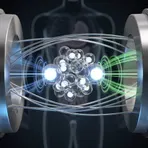
Tiny parts of atoms take in and send out energy inside a strong magnetic field
 2
7.1
2
7.1
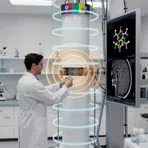
A method that uses magnets to make images of the inside of the body or to find a molecule's structure
 1
6.8
1
6.8
A method that uses strong magnets and radio waves to make images or study molecules
Surface Forms
Morphology
The phrase is compositionally built from 'proton' + 'magnetic' + 'resonance', so a learner who knows the words can infer a general idea of protons resonating in a magnetic context. However, the precise technical meaning (absorption and re‑emission of electromagnetic radiation at characteristic frequencies and its applications like MRI) requires domain knowledge beyond B1, so the meaning is only partially predictable.
Etymology
Proton magnetic resonance imagines tiny proton particles as little magnets inside a strong magnetic field; when radio waves hit them they take in energy and send it back as a small 'signal'. That's why the phrase names the physical effect used to study molecules and to make medical 'images' like MRI.