

nuclear magnetic resonance
 1
6.8
1
6.8

- noun
- /ˈnjuːklɪər ˈmæɡnətɪk ˈrɛnəns/
- Specialized
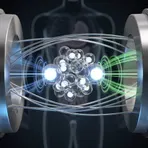
- Nuclear magnetic resonance (NMR) helps decipher the three-dimensional structure of a molecule by observing its nuclear spins.
- nuclear magnetic resonance (NMR)
- nuclear magnetic resonance spectroscopy
- nuclear magnetic resonance facility
Loading YouTube…
Watch on YouTubeA lot of high energy physics such as nuclear magnetic resonance imaging occurs.
- A lot of high energy physics such as nuclear magnetic resonance imaging occurs.
Examples
-
Pedersen and colleagues (2008) recently conducted just such a study using nuclear magnetic resonance (NMR) spectroscopy.
Academic text (2010) -
Figure 2. Nuclear magnetic resonance image of a tumor implanted in the hind leg of a rabbit.
Academic text (2003) -
A lot of high energy physics such as nuclear magnetic resonance imaging occurs.
-
Last time we said in the setup for nuclear magnetic resonance, we have a large magnetic field.
-
Multidimensional Fourier-transform methods were developed for nuclear magnetic resonance.
Academic text (2012) -
Magnetic resonance imaging had its origin in nuclear magnetic resonance spectroscopy.
Academic text (1995) -
Now a nearly ubiquitous medical diagnostic tool, magnetic resonance imaging may be the first context in which citizens encounter nuclear magnetic resonance.
Academic text (1993) -
In early 1946, the Physical Review published letters from the two discoverers of nuclear magnetic resonance describing their independent detections of NMR in bulk matter.
Academic text (1993) -
Nuclear magnetic resonance spectroscopy (NMR) has provided evidence that methylamines accumulate in chronic renal failure.
Academic text (1991) -
Nuclear magnetic resonance is widely used in medical imaging to create detailed pictures of organs.
Synonyms
 5
4.8
5
4.8
Tiny parts of atoms take in and send out energy inside a strong magnetic field
 2
7.1
2
7.1
A method that uses magnets to make images of the inside of the body or to find a molecule's structure

A method using a strong magnet and radio waves to make images of body parts or molecules
Surface Forms
Morphology
nuclear + magnetic + resonance
The constituents 'nuclear' (about atomic nuclei), 'magnetic' (relating to magnetism), and 'resonance' (vibrational/excitation at a frequency) make clear that this is a physical phenomenon involving nuclei and magnetic resonance, so learners can form a rough idea from the parts. However, the precise technical sense—nuclei absorbing and re-emitting electromagnetic radiation and the specific applications in imaging and chemical analysis—requires domain knowledge beyond B1, so the meaning is only partially predictable from the words alone.
Etymology
Nuclear magnetic resonance gets its name from what really happens: tiny atomic parts called nuclei act like little spinning tops that wobble in a magnetic field when you hit them with the right radio wave, and this matching motion is resonance, which makes the nuclei send back a small signal. That's why the name is used for methods that 'listen' to those signals to 'look inside' objects or to study the parts of molecules.