
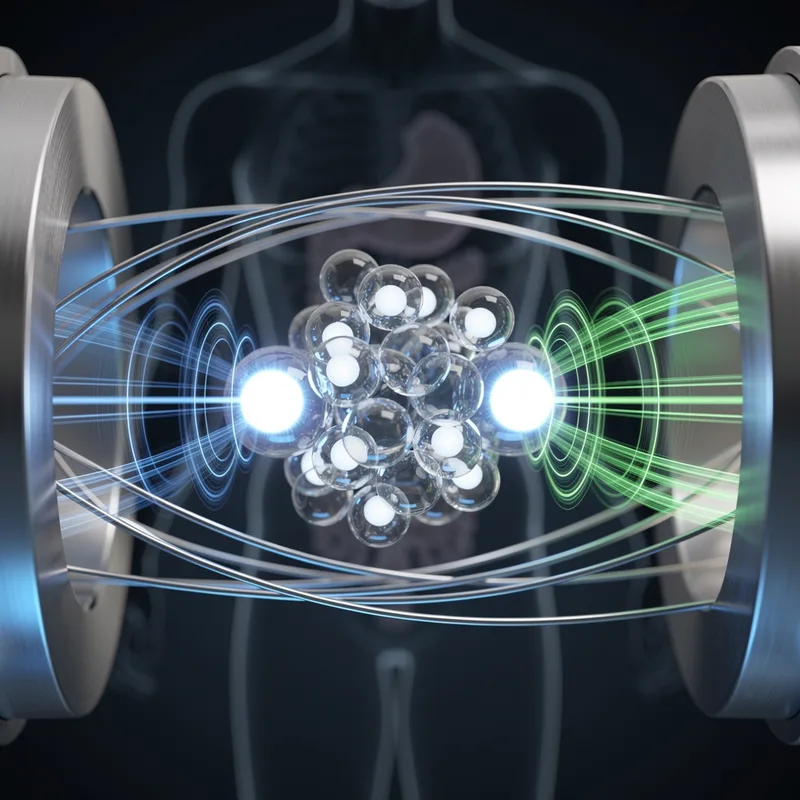
magnetic resonance
 5
4.8
5
4.8

- noun
- /mæɡˈnɛtɪk ˈrɛzənəns/
- Specialized
- Brain studies usually work with functional magnetic resonance imaging that tells you which parts of the brain are active.
- magnetic resonance imaging
- Nuclear magnetic resonance
- magnetic resonance spectroscopy
Loading YouTube…
Watch on YouTubeAnd then they hired on a different firm who put people in fMRI functional magnetic resonance imaging machines, put them in there, ask the same questions.
- And then they hired on a different firm who put people in fMRI functional magnetic resonance imaging machines, put them in there, ask the same questions.
- Functional magnetic resonance imaging F MRI.
- Some of you will be doing magnetic resonance and they will be thinking entirely about the magnetic field.
- A lot of high energy physics such as nuclear magnetic resonance imaging occurs.
Examples
-
Magnetic resonance imaging had its origin in nuclear magnetic resonance spectroscopy.
Academic text (1995) -
Digital image storage and display are used routinely in X-ray CT and magnetic resonance imaging.
Academic text (1995) -
A lot of high energy physics such as nuclear magnetic resonance imaging occurs.
-
So lupus is a bad disease that shows up in these magnetic resonance images in certain ways.
-
CT and, more recently, magnetic resonance imaging have largely overcome these difficulties.
Academic text (1995) -
During the study period, new diagnostic tools like computed tomography and magnetic resonance imaging were introduced.
Academic text (2012) -
The diagnosis was confirmed by conventional angiography or magnetic resonance imaging and angiography in all patients.
Academic text (1996) -
No patient exhibited clinical or magnetic resonance imaging evidence of a rotator cuff tear.
Academic text (2015) -
Most of these findings have been described on computed tomography (CT), although magnetic resonance imaging is also performed.
Academic text (2008) -
Doctors often request a magnetic resonance imaging scan to diagnose potential brain injuries.
Synonyms
 1
6.8
1
6.8
A method that uses strong magnets and radio waves to make images or study molecules
Surface Forms
Morphology
The phrase combines 'magnetic' (relating to magnetism) with 'resonance' (a resonant/vibrational response); a B1 learner who knows both words can infer it denotes a resonance phenomenon that involves magnetic fields even if they lack technical details. This adj+noun composition follows regular English formation and is cross-linguistically transparent, so the overall meaning is derivable from the parts.
Etymology
Magnetic resonance combines magnetic, which is like a tiny magnet, and resonance, which is like something that 'rings' when you tap it. One simple image is tiny particles in the body acting like little magnets that 'ring' and send back a signal when we nudge them in a magnetic field, and that 'ringing' signal is why the term now means the effect used to make pictures of the inside of the body.