
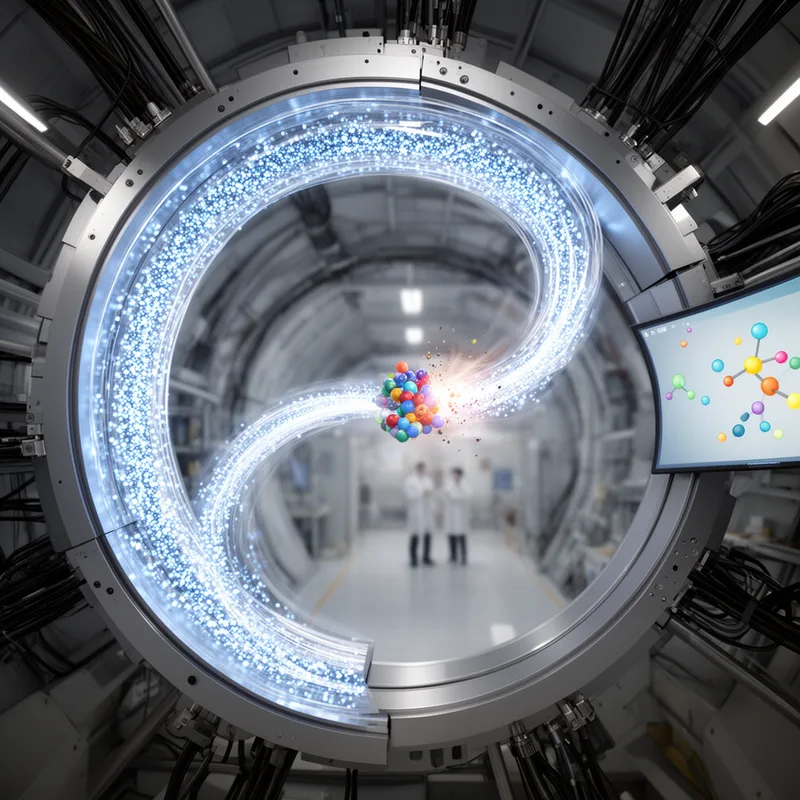
proton accelerator
 1
6.8
1
6.8

- noun
- /ˈproʊtɒn əˈsɛlɪˌreɪtər/
- Specialized
- This includes fusion, proton accelerators, and other reactor types, including heavy-water reactors.
Examples
-
The researchers used a proton accelerator to collide protons at high speeds in their experiments.
-
The university built a new proton accelerator to advance their research in particle physics.
-
It's a portable proton accelerator.
-
To create them in quantities sufficient for serious study, a terrestrial proton accelerator of correspondingly high energy was required.
Academic text (2004) -
This is further reduced by a factor of ten or so for the efficiency of the proton accelerator, leaving a net efficiency of perhaps 1.5 x 10^-9, i.e., about one part in a billion!
Academic text (2000) -
Look around for some extra neutrons from more enriched core fuel, or from lasers, or from proton accelerators, or from fusion so that you can breed failsafe U232/U233.
Blog text (32) -
In high-energy physics, a proton accelerator is essential for studying particle collisions.
Synonyms


 1
9.9
1
9.9
A large machine that speeds up protons for physics experiments
A machine that makes protons travel very fast around a ring
A large machine that speeds up protons for physics research
How Energetic
- Specialized
4
9.3

- Specialized
- Specialized
1
7.0
- Specialized
1
6.8
- Specialized
3
9.9
- Specialized
Surface Forms
Morphology
The phrase is directly compositional: 'accelerator' is a device that increases speed/energy and 'proton' names the particle being accelerated, so the combined meaning ('a device that accelerates protons') follows transparently from the constituents. This structure is a straightforward noun+noun technical compound found across languages, so a B1 learner who knows both words would be able to infer the MWE's meaning.
Etymology
Proton accelerator is a simple name: proton is the tiny positive particle inside an atom and accelerator means something that makes things go faster. These machines speed up protons until they smash into other particles so scientists can study what atoms are made of, so the phrase means 'a machine that makes protons very fast for experiments'.