
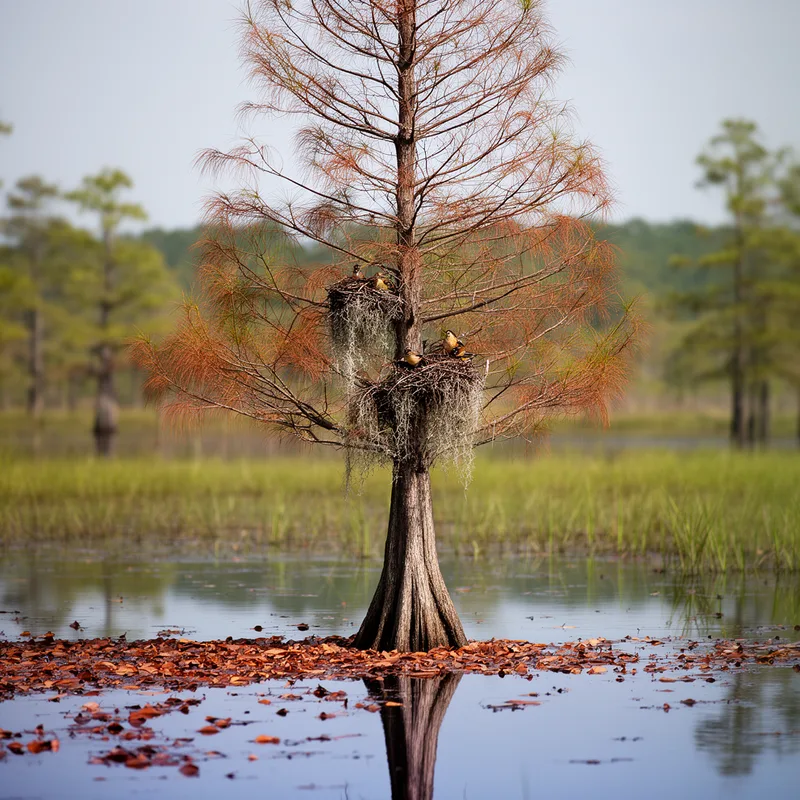
pond cypress
- noun
- /pɒnd ˈsaɪprəs/
- US
- The pond cypress grows well in wetland areas, thriving alongside other aquatic plants.
Examples
-
Unlike the bald cypress, the pond cypress prefers still, acidic waters.
-
Many birds nest in the branches of the pond cypress during spring.
-
The pond cypress is commonly found in shallow wetlands across the southeastern United States.
-
The pond cypress thrives in wetland areas.
-
Many pond cypresses can be found in Florida.
-
During our hike, we observed several pond cypress trees standing tall near the edge of the swamp.
-
The pond cypress is known for its unique ability to survive in standing water and contribute to wetland ecosystems.
Synonyms

 15
5.3
15
5.3

A tall evergreen tree with dark, flat leaves and small round cones
 3
3.5
3
3.5
A tall evergreen tree with dark, flat leaves and small round cones


 1
7.4
1
7.4
A large tree that loses its leaves and grows in swamps in the southeastern United States

A tree in the cypress family that loses its leaves and grows near ponds in the southeastern United States

A tall tree that makes cones and grows in swamps, like the bald cypress

A large tree with a wide trunk base that grows in southern United States swamps
Surface Forms
Morphology
pond + cypress
The phrase denotes a type of cypress associated with ponds: its meaning is directly derivable from combining 'pond' (a small still water) with 'cypress' (a tree), so a learner who knows both words can infer it refers to a cypress found in pondy/swampy areas. This noun–noun species/habitat naming pattern is common in English and cross-linguistically regular, making the expression immediately comprehensible to B1 learners who know the constituents.
Etymology
Pond cypress is literally a cypress that grows in a pond or other shallow 'wet places', so the name tells you it is a tree that lives in wet ground.