
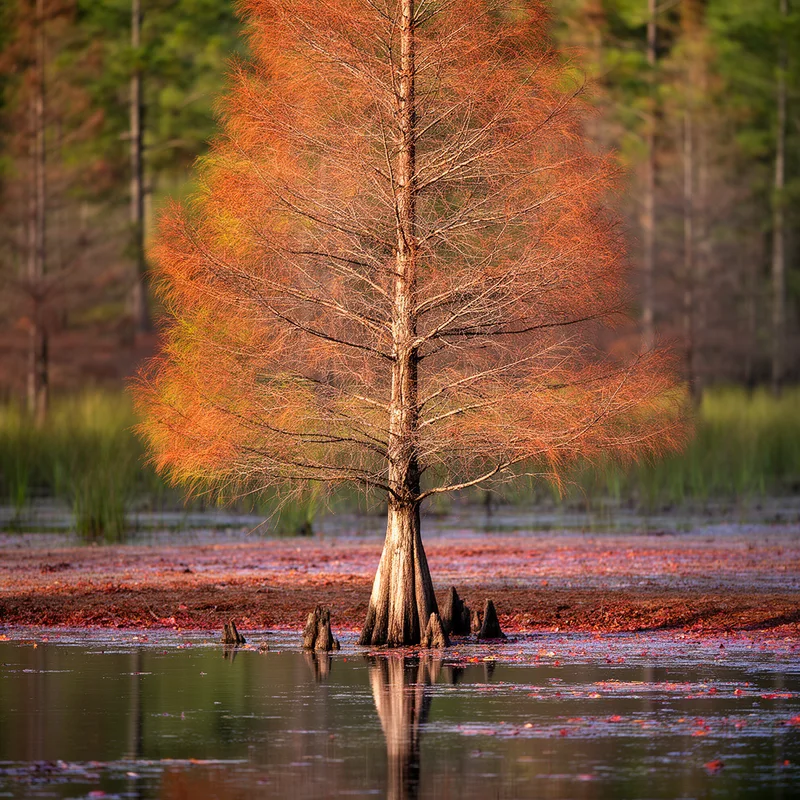
Taxodium ascendens
- noun
- /tæˈzoʊdiəm əˈsɛndɛnz/
- Specialized
- The wetland restoration project included planting several Taxodium ascendens saplings along the pond’s edge.
Examples
-
Unlike the bald cypress, Taxodium ascendens typically grows in still, shallow waters.
-
Many parks in Florida feature the Taxodium ascendens tree.
-
Scientists studied the growth rings of Taxodium ascendens to understand regional climate changes.
-
The Taxodium ascendens thrives in wetland areas.
-
The wetland restoration project included planting several Taxodium ascendens saplings along the pond’s edge.
-
Many parks in Florida feature the Taxodium ascendens tree, providing shade and habitat for wildlife.
-
Scientists studied the growth rings of Taxodium ascendens to understand regional climate changes.
Synonyms

A tree that loses its leaves and grows in wet places in the southern United States
Surface Forms
Morphology
Taxodium + ascendens
This is a scientific binomial (genus + species): knowing 'Taxodium' tells a learner it is a kind of wetland conifer, so the broad meaning 'a Taxodium tree' is derivable. However, the species epithet 'ascendens' is Latin and not transparently informative to an average B1 learner (and it does not give the common name 'pond cypress' without botanical knowledge), so the full, specific referent is only partially predictable.
Etymology
Taxodium ascendens comes from old Latin words that describe the tree: Taxodium refers to a yew-like tree and ascendens means 'rising' or 'growing up'. So the name paints a simple picture of a cypress that grows upright at the edge of ponds, which helps you remember it is the 'pond cypress'.

