
polyploidy
- noun
- /ˌpɒlɪˈplɔɪdi/
- Specialized
- Polyploidy is frequently observed in certain plant species, leading to increased genetic diversity.
- polyploidy and hybridization
- polyploidy and diploidy
- chromosomal polyploidy
Examples
-
Homosporous plants have been considered stellar exemplars of polyploidy and inbreeding.
Academic text (2002) -
In addition, some tissues in adults develop polyploidy.
Academic text (2003) -
A revised perspective on polyploidy in homosporous plants.
Academic text (2002) -
However, polyploidy is uncommon in infants and was not detected in cases or controls.
Academic text (2003) -
Vegetative reproduction correlates highly with both polyploidy and hybridization in angiosperms.
Academic text (1996) -
Some species have been modified by hybridization or polyploidy to produce infertile individuals to culture (Hulata 2001).
Academic text (2009) -
Thus, from the standpoint of genetic expression, an absolute chromosome number cutoff between diploidy and polyploidy does not exist.
Academic text (2002) -
In the evolutionary context, Haldane deals for the first time with inversions and translocations, polyploidy, and hybridization.
Academic text (1992) -
About 44% of extant homosporous plants are polyploids, even if polyploidy is defined as being above generically basal chromosome numbers (Vida 1976).
Academic text (2002) -
Researchers are studying the effects of polyploidy on crop yields and resilience to environmental changes.
How Many Sets
- Specialized

- Specialized
- Specialized
- Specialized
- Specialized
Surface Forms
Morphology
polyploidy = polyploid (semi-transparent) = poly + ploid + y
The noun is a regular -y nominalization of the adjective 'polyploid', so the derivation itself is straightforward.
Etymology
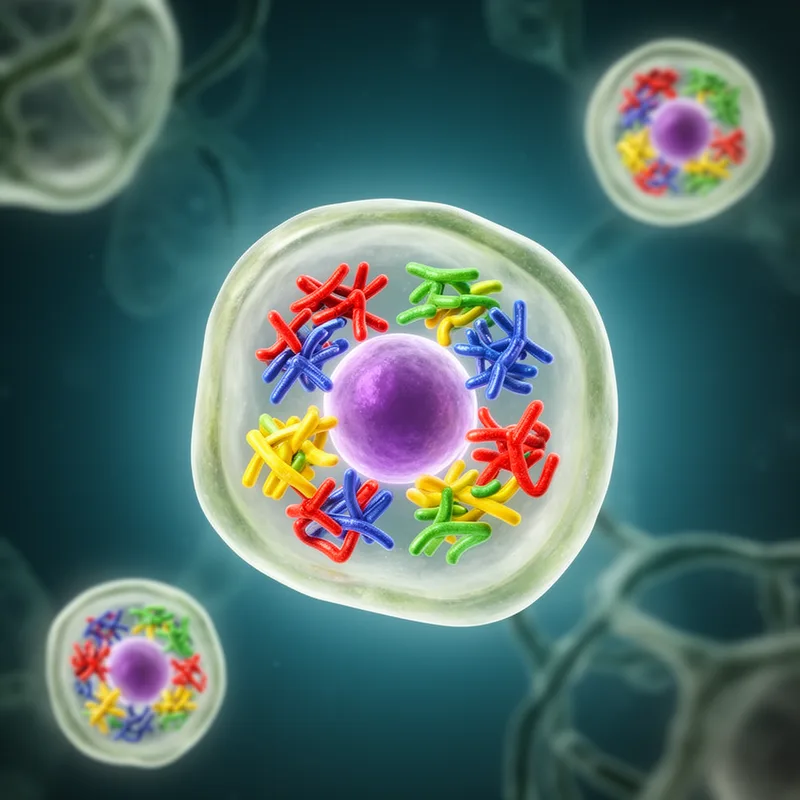
Polyploidy comes from the parts poly- meaning 'many' (as in polygon) and -ploid meaning 'fold' or 'layer'. So polyploidy literally means 'many-fold', which helps you remember it refers to cells that have 'many' sets of chromosomes instead of the usual two.

