
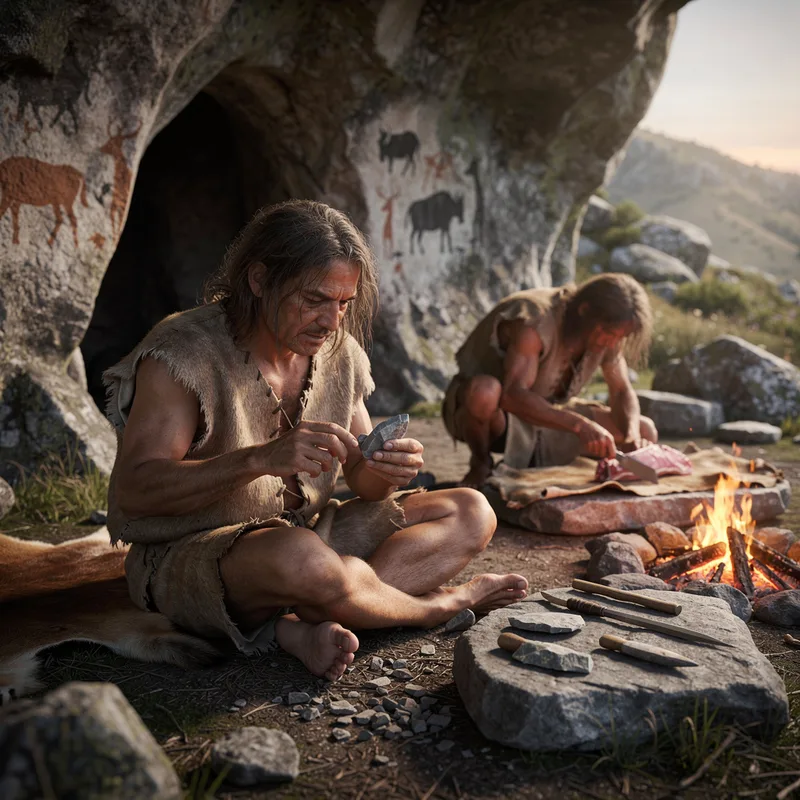
paleolithic
 5
8.4
5
8.4

- adjective
- /ˌpeɪliəˈlɪθɪk/
- Specialized
- It was inhabited as early as the Paleolithic Period.
- Paleolithic cave
- Paleolithic hunters
- Paleolithic gatherers
Examples
-
Frequently, in Paleolithic art, water is associated with birds, fish, and phallic images.
Academic text (1995) -
ITALY: Once thought to be almost exclusively meat-eaters, Paleolithic people in Europe may have munched on flatbread as well.
Academic text (2011) -
- A major find from the Paleolithic era.
-
All the Paleolithic standing stones in the country.
-
But there were no skilled Paleolithic hands to shape it.
Fiction book (1999) -
Everything important that has happened to humans since the Paleolithic era is due to environmental influences.
Academic text (1999) -
Handmade in the Paleolithic period.
-
Our skulls are smaller than those of our brothers in the Paleolithic period.
Fiction book (1991) -
Nikki: This looks very similar to the Paleolithic cave art... that was discovered in the south of France and Spain.
-
The tools discovered in the cave date back to the Paleolithic period, showcasing early human craftsmanship.
Synonyms
 47
5.2
47
5.2
From the time before people wrote things down

 1
6.9
1
6.9
A time before people wrote things down
Compounds

- Specialized
1
9.8
The late part of the Stone Age when only modern humans lived, ending about 10,000 BC

- Specialized
1
9.9
The second part of the Old Stone Age when Neanderthals lived, until about 35,000 BC

- Specialized
1
6.7
The first part of the Stone Age when people made simple stone tools
- Specialized
A very early time in human history when people first used simple stone tools like hand axes
How Early

Surface Forms
Morphology
Etymology
Paleolithic comes from Greek parts paleo- ('old') and -lithic ('stone'). So paleolithic literally means 'old stone' and refers to the earliest part of the Stone Age when people used simple stone tools.