
Middle Paleolithic


 1
9.9
1
9.9
- noun
- /ˈmɪdəl ˌpeɪliəˈlɪθɪk/
- Specialized
- At the bottom, a sheet of paper in a plastic sleeve reads "Middle Paleolithic," marking the cave's lowest, and therefore oldest, layer.
- Middle Paleolithic layers
Examples
-
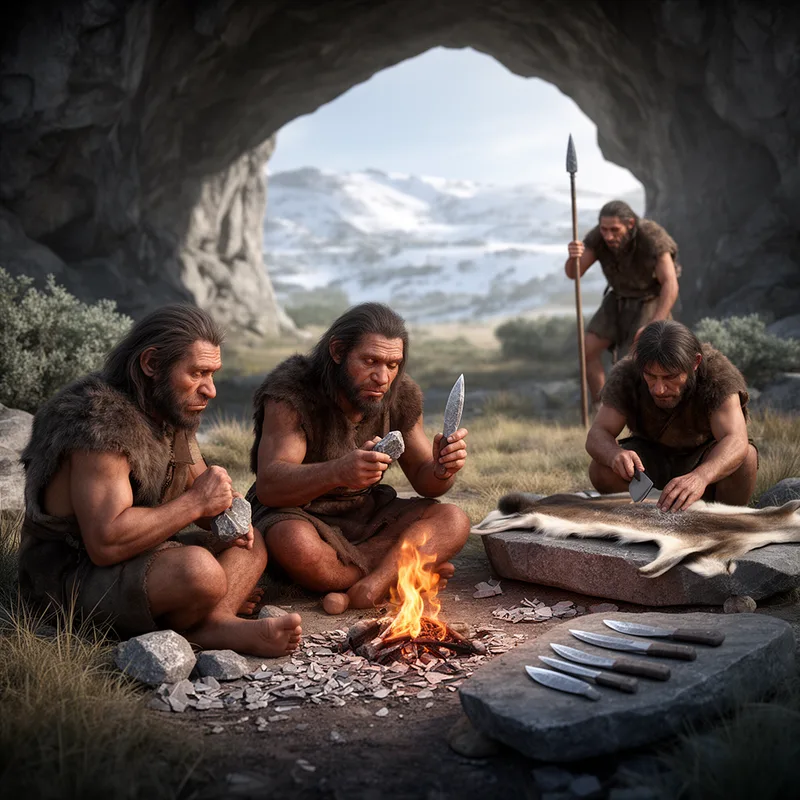
Archaeologists discovered tools made during the Middle Paleolithic period, highlighting the skills of early humans.
-
A barren or sterile layer sits atop the Middle Paleolithic.
Academic text (2007) -
Meanwhile, artifacts from the Middle Paleolithic layers came back with dates thousands of years younger than pieces from the Aurignacian.
Academic text (2007) -
A significantly older Aurignacian might overlap with the Neanderthal era or Middle Paleolithic.
Academic text (2007) -
"Judging by the low artifact density in the Middle Paleolithic and sterile layers, we conclude modern people came into a nearly empty region," says Michael Bolus, a German archaeologist who works closely with Conard.
Academic text (2007) -
The Middle Paleolithic era provides key insights into the life and culture of Neanderthal communities.
-
Fossils from the Middle Paleolithic layers suggest that Neanderthals adapted to varied climates and environments.
Surface Forms
Morphology
The phrase is a straightforward compositional combination of 'middle' (an intermediate stage) and 'Paleolithic' (the named prehistoric period), so its meaning as the middle subdivision of the Paleolithic is directly derivable. This type of period-labeling (Middle + period name) is common cross-linguistically and follows normal English noun-modifier composition, making it readily understandable to learners who know the constituent words.
Etymology
Middle Paleolithic comes from calling it the middle part of the 'old Stone Age'. People used Middle to mean the time between earlier and later parts and Paleolithic to mean the 'old Stone Age', so the name means the period when Neanderthals lived and made more advanced stone tools.