
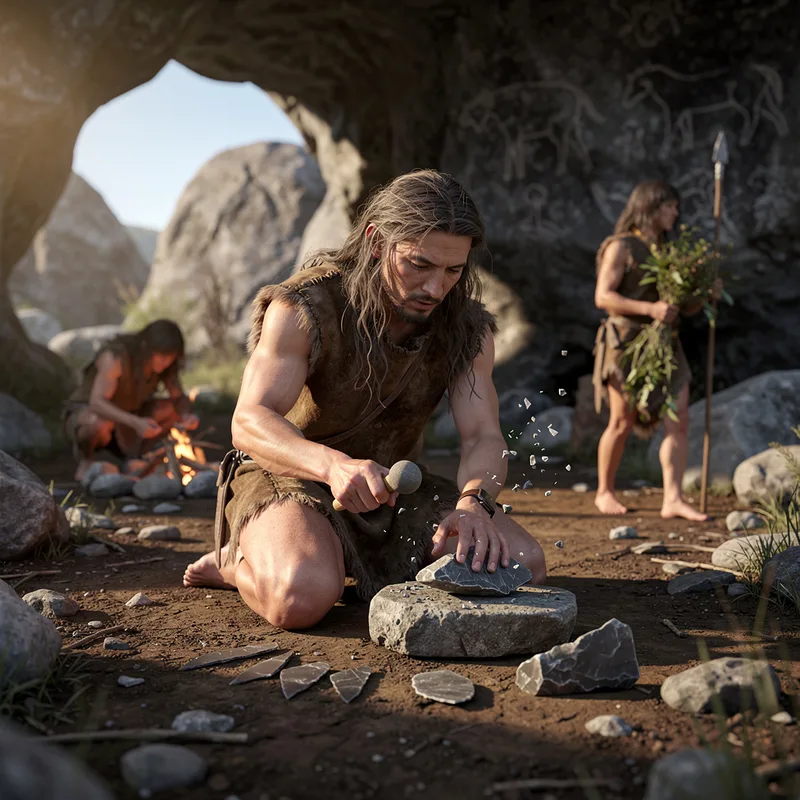
Paleolithic
 1
9.9
1
9.9

- noun
- /ˌpeɪliəˈlɪθɪk/
- Specialized
- So let's go right back to the Paleolithic era and in particular to Lascaux Cave in France.
- the Middle Paleolithic
Examples
-
The tools discovered in caves date back to the Paleolithic period, showcasing some of the earliest human craftsmanship.
-
What if a man from the upper Paleolithic survived until the present day?
-
Well, we think men of the upper Paleolithic were as intelligent as we are.
-
The spiral is particularly interesting and appears as early as the Paleolithic as a decorative element.
Academic text (2000) -
In the transition from the Paleolithic to the Mesolithic period, however, the role of women did not change significantly.
Academic text (2000) -
Though late Paleolithic in standard periodization, these people had been experimenting with wild crop harvesting thousands of years before the development of agriculture elsewhere.
Academic text (2000) -
Archaeologists found evidence of art and engraving that dates to the Paleolithic, revealing the creativity of early humans.
-
The Paleolithic age is known for the development of basic stone tools, marking a significant advancement in human history.
Synonyms


 1
6.7
1
6.7
The first part of the Stone Age when people made simple stone tools
Compounds

- Specialized
1
9.8
The late part of the Stone Age when only modern humans lived, ending about 10,000 BC

- Specialized
1
9.9
The second part of the Old Stone Age when Neanderthals lived, until about 35,000 BC
- Specialized
1
6.7
The first part of the Stone Age when people made simple stone tools
- Specialized
A very early time in human history when people first used simple stone tools like hand axes
Surface Forms
Morphology
Etymology
Paleolithic comes from the Greek parts palaios ('old') and lithos ('stone'), so it literally means 'old stone'. That's why the Paleolithic period is called the 'Old Stone Age' — the time when people first made and used stone tools.