
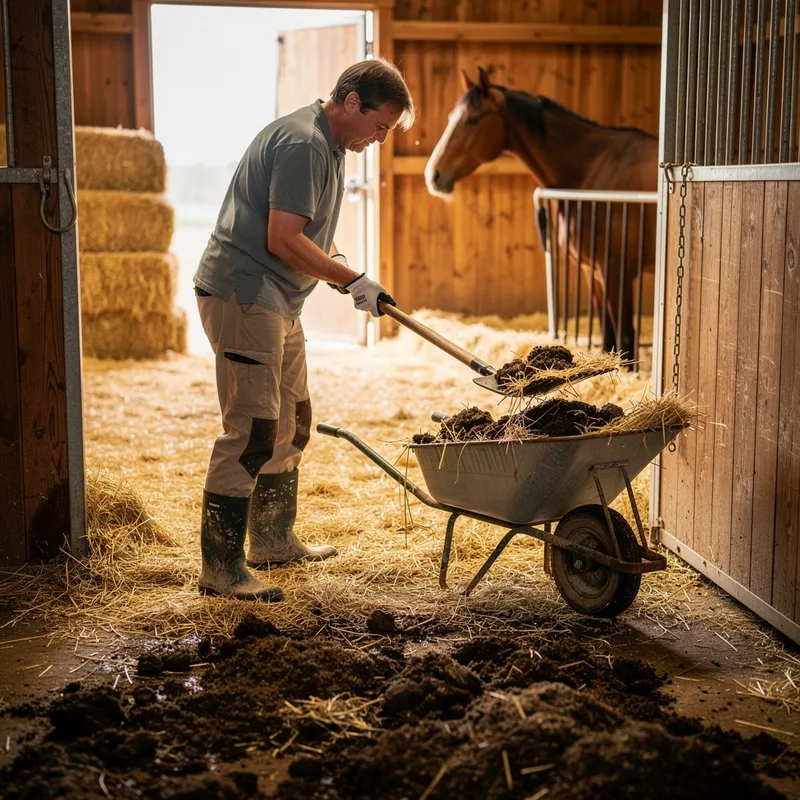
to muck out
 3
6.5
3
6.5

- phrasal verb
- /mʌk aʊt/
- Bob Linwood is in his barn, mucking it out.
- muck out stalls
- muck out a barn
- muck out a stable
Examples
-
Diego, our groom from Santo Domingo Pueblo, finishes mucking out the other stalls and stops to pet the foal.
Fiction book (1998) -
At least a half mile behind us was Stable-Mart, the sorry excuse for a stable, where I had the royal job of mucking out stalls.
Fiction book (2002) -
"I'll walk this boy around a bit while you muck out."
Fiction book (2000) -
Muck out that stall, and then bring that horse on in and put him inside.
-
Muck out that stall.
-
But Dusty had a pitchfork for mucking out the ponies' corral.
Fiction book (1992) -
Inside the barn, stableboys were busy mucking out, so the air was perfumed with the smells of manure, hay, and mud.
Fiction book (1995) -
Dozens of grooms were at work, currying and combing, mucking out, mending tack.
Fiction book (1992) -
After finishing breakfast, I went to muck out the horse's stable to keep it clean.
-
It's important to muck out the animal pens regularly to maintain hygiene.
Synonyms
 2
6.8
2
6.8
To remove dirt and waste from a mine or tunnel

To empty dirty liquid or other waste from a container like a bucket
How Clean
- Specialized
9
7.0
 18
3.7
3
6.5
∞
1.0
531
1.0
18
3.7
3
6.5
∞
1.0
531
1.0
Surface Forms
Morphology
The meaning is directly built from 'muck' (to clear out dirt or waste) plus the particle 'out' (remove from the interior), so 'muck out' straightforwardly means to remove and clean away waste from a place. This verb+particle composition is a common, predictable English pattern, so a B1 learner who knows both constituents would reliably infer the MWE's meaning.
Etymology
The phrasal verb muck out comes from farm work: muck was the dirty animal waste in stables, and workers would shovel it out into a wheelbarrow. So muck out now means 'to clean waste', especially manure, from a stable or animal pen.