

marsh plant
- noun
- /mɑrʃ plænt/
- Hammer believes that harvesting marsh plants in a CW is not necessary and could be harmful since much of the treatment activity is done by microbes that thrive on a matrix of dead, dying vegetative matter.
- salt marsh plants
Examples
-
"The keys to constructed wetlands systems are marsh plants, aeration, and drainage," says Hunt.
Academic text (2006) -
The majority are aquatic plants (including submerged plants, marsh plants, and shoreline trees and shrubs), fish, algae, mollusks, and crustaceans.
Academic text (1994) -
Turnover times used were 1.4 days for phytoplankton and 3 months for marsh plants.
Academic text (2003) -
Actually, the focus is on a particular species of reed called "phragmites communis," a second cousin of the common marsh plant.
Academic text (1996) -
Water buffaloes eat grass, reeds, and sedges (marsh plants).
Fiction book (2002) -
The experimental systems were initiated with a combination of homogenized sediments and sediment plugs containing marsh plants taken from nearby natural habitat.
Academic text (2003) -
The rapid initial growth evident in our experiment early on implies that the treatment effects observed in such short-duration experiments may be confounded by artifacts of scale associated with experimental extent scales that are far shorter than the natural extent scales that characterize the life cycles of marsh plants.
Academic text (2003) -
The wetland was home to many different marsh plants, including tall grasses and vibrant flowering species.
-
During our hike, we admired the variety of marsh plants that thrived in the shallow waters of the swamp.
-
The environmental study focused on how marsh plants help stabilize the shoreline and improve water quality.
Synonyms

 2
2.2
2
2.2

A plant that lives in water, attached to the bottom or floating
 1
3.4
1
3.4
A plant that grows in or near water, like a water lily
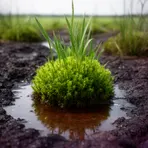
A plant that grows in very wet, soft ground like bogs and marshes and can live in poor soil

A plant that grows in soft wet ground near water, like cattails

A plant that lives in water or very wet ground

A plant that grows in water, like water lilies or reeds
How Aquatic

Surface Forms
Morphology
The meaning 'a plant that grows in marshy, waterlogged areas' is directly and compositionally derived from combining 'marsh' (wetland) with 'plant' (vegetation). This straightforward noun-noun compounding follows common English and cross-linguistic patterns, so a B1 learner who knows both words will readily understand the MWE.
Etymology
Marsh plant is made from the words marsh (soft, wet ground) and plant (a living green thing). So it gives the clear image of a plant growing in wet ground, and now means 'a plant that grows in soft, wet, or marshy areas'.