

lunation
- noun
- /luːˈneɪʃən/
- Specialized
- The calendar is based on the lunar cycle, which consists of twelve lunations each year.
- lunation is a month
- only lunations
Examples
-
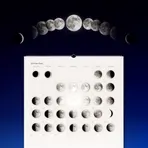
Clearly we do not see a constant magnitude of the Moon at the full phase; instead, we find a variety of full Moons, one for each lunation, or set of phases that repeats itself every 29.5 days.
Academic text (2004) -
A lunation lasts about 29.5 days from one New Moon to the next.
-
Understanding lunation helps astronomers track the Moon's phases accurately.
Synonyms

 61
3.7
61
3.7

A period of about 29 to 30 days used in some calendars
 1
3.6
1
3.6
About 29 and a half days from one new moon to the next

The time between one new moon and the next, about 29.5 days
Surface Forms
Morphology
lunation = lunar (semi-transparent) = lun + ation
The formation uses the Latin combining stem 'lun-' plus the productive English nominal suffix '-ation'; learners who know 'lunar' or the connection to the Moon will see the relation, but many learners know 'moon' rather than 'lun-', so the link is not fully transparent.
Etymology
Lunation comes from the Latin luna ('moon') and the ending -ation, which turns a word into a period or event, like the familiar word lunar. So a lunation is one full 'moon' cycle from new moon to new moon, about 29.5 days.