
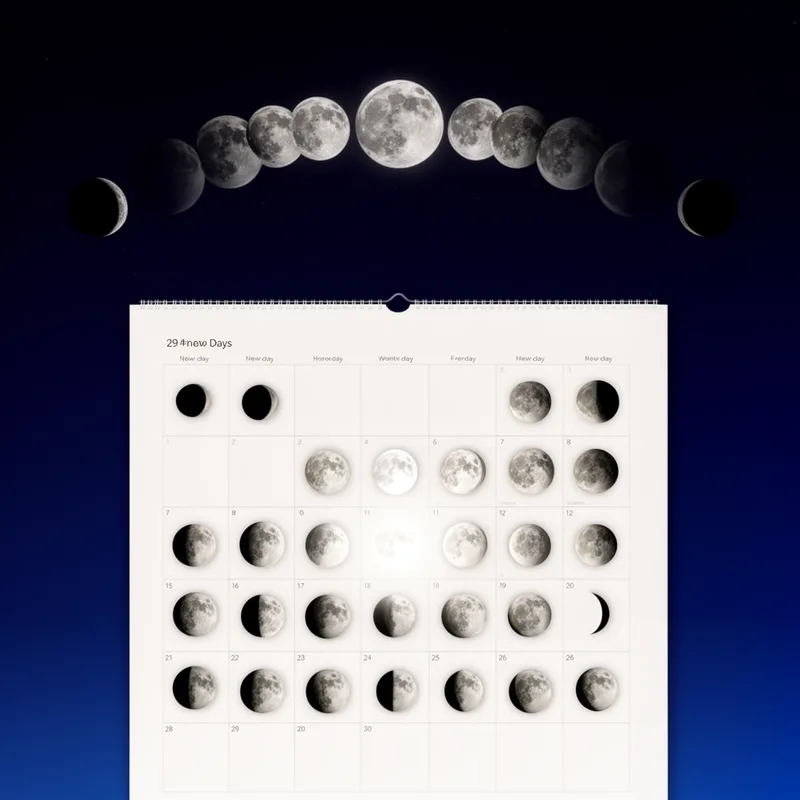
lunar month
 1
3.6
1
3.6

- noun
- /ˈluːnər mʌnθ/
- Specialized
- They fast during daylight hours for the lunar month of Ramadan to strengthen their willpower and their reliance on God and Hajj.
- the fifth lunar month
- the eighth lunar month
- the Japanese lunar month
Examples
-
In the fourth lunar month of 1410, the court sent Pak to Ming China a third time.
Academic text (2016) -
A second group arrived in the Korean capital in the third lunar month of 1396.
Academic text (2016) -
One day short of a lunar month.
-
To me will belong spring, and from there seven lunar months.
Academic text (1990) -
The fourteenth of the fifth lunar month is the day of her death.
Academic text (2009) -
The Jewish chronology is based on lunar months and is therefore very hard to correlate with a standard solar calendar.
Academic text (1991) -
King T'aejo responded to the fourth dispatch, which he received in the twelfth lunar month of 1397.
Academic text (2016) -
More specifically, the country name 'Choson' was selected on or by the seventeenth day of the seventh lunar month of 1392.
Academic text (2016) -
The first civil examination supervised by the Royal Confucian Academy may have been that held in the tenth lunar month of 1362.
Academic text (2016) -
A lunar month lasts about 29.5 days and is measured from one new moon to the next.
Synonyms
 ∞
1.0
∞
1.0
A period of about four weeks or one of the twelve parts of the year
 61
3.7
61
3.7
A period of about 29 to 30 days used in some calendars
The time from one new moon to the next, about 29 and a half days

The time between one new moon and the next, about 29.5 days
Surface Forms
Morphology
The compound is directly compositional: 'lunar' means 'relating to the moon' and 'month' is a unit of time, so a learner can infer it denotes a month defined by the moon's cycle. This astronomical concept is cross-linguistically attested (e.g. Spanish 'mes lunar', French 'mois lunaire') and, while slightly technical, is predictable to a B1 learner who knows both constituents.
Etymology
The noun lunar month comes from watching the moon move from one 'new moon' to the next; the part lunar means 'about the moon' and month means a roughly month-long period, so the phrase names the time of 'about 29.5 days' between successive new moons.