
liquefaction
 1
7.4
1
7.4

- noun
- /ˌlɪkwəˈfækʃən/
- Specialized
- We've got the conditions for liquefaction and the likelihood now of future earthquakes.
- liquefaction during an earthquake
Examples
-
All rocks, therefore, postdate this early liquefaction.
Academic text (1990) -
It's called soil liquefaction.
-
Regarding liquefaction, is there a fault nearby?
Blog text (3) -
But when the human didn't melt into a puddle, he figured it was liquefaction of the soil.
Fiction book (2001) -
One of our criteria is firm ground, in terms of avoiding not just liquefaction in an earthquake but also general subsidence over time and more intense vibrations.
Blog text (3) -
In addition, about 17 percent of the region is susceptible to liquefaction, and other areas, especially the southern part of the metropolitan region, face risks of earthquake-induced landslides.
Academic text (1993) -
We're not seeing soil liquefaction we'd expect... ...or any evidence of fracture propagation within the tectonic plates.
-
I suppose geologists might take the metaphor and extend it to the seismic phenomenon of "liquefaction," when an earthquake shakes the ground so strongly that the earth itself behaves as a liquid.
Academic text (2000) -
A bog burst occurs when "great chunks of bog begin to move as a unit due to the liquefaction of the peat lower down" (Feehan and O'Donovan 1996, 399).
Academic text (2002) -
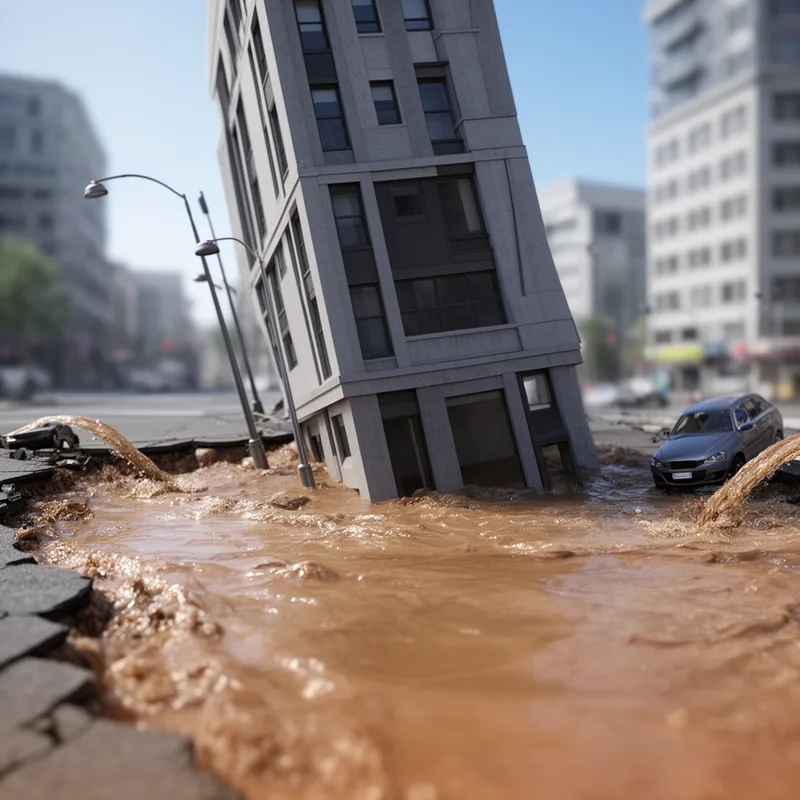
The earthquake caused severe liquefaction, turning solid ground into a flowing mass of sand and water.
Synonyms

Turning a solid into a liquid by melting
Antonyms

How Liquid

Surface Forms
Morphology
Etymology
The word liquefaction again comes from liquid and liquefy, meaning 'to make liquid'. That is a useful image: during an earthquake the ground can 'turn to liquid' and lose its strength, which is why engineers call that process liquefaction.