

isomorphy
- noun
- /ˌaɪsəˈmɔrfi/
- Specialized
- The isomorphy between the adult and larval forms allows scientists to trace evolutionary relationships.
Examples
-
Some plant groups are notable for their isomorphy throughout the different generations in their life cycles.
-
Many marine animals display isomorphy in their skeletal structures across different species.
-
The concept of isomorphy is crucial in evolutionary biology.
-
Many species exhibit isomorphy in their physical structures.
-
Many marine animals display isomorphy in their skeletal structures across different species.
-
Some plant groups are notable for their isomorphy throughout the different generations in their life cycles.
-
The isomorphy between the adult and larval forms allows scientists to trace evolutionary relationships.
Synonyms
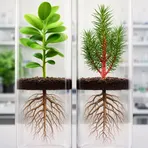
A similarity of shape or structure across organisms and their parts

A similar shape in animals, plants, or objects that are not closely related
Antonyms


How Similar
- Specialized
 15
6.5
15
6.5

- Specialized
157
2.7
105
3.0
3
4.5
Surface Forms
Morphology
isomorphy = isomorph (semi-transparent) = iso + morph + y
The noun is formed by adding the productive suffix '-y' to the technical base 'isomorph', a regular and predictable derivation.
Etymology
The word isomorphy comes from two Greek parts: iso- meaning 'equal' and morph meaning 'shape', the same root you see in morphology. So, scientists use isomorphy to say that two organisms or structures have the 'same' or very similar form.