
isomorphism
 1
9.6
1
9.6

- noun
- /ˌaɪsəˈmɔrfɪzəm/
- Specialized
- The mathematician demonstrated an isomorphism between the two algebraic structures, showing they share the same properties.
Examples
-
That's a proof that there can't be an isomorphism between the two graphs.
-
Like you show that this is an isomorphism, then you would say G is isomorphic to H and they're basically the same group.
-
Given how few they are, it is likely that there is just one solution up to isomorphism in both cases.
Blog text (23) -
The main isomorphism I had to deal with was between the data structures of the first and second types of machines.
Blog text (8) -
That's the official definition of isomorphism for digraphs.
-
Given Leibniz's characterization of God's reasons for choosing which world to create, we can be confident that this isomorphism holds.
Academic text (1998) -
Either we need to find a CH-like isomorphism for pi calculus, or we need to find another model for concurrency.
Blog text (8) -
High-level projections and isomorphisms between data representations.
Blog text (8) -
In 1976, a Chinese scholar pointed out that there is an isomorphism between machines and natural regularities (Jin 1986).
Academic text (1991) -
Lonergan says the same thing in a technical way when he speaks of the isomorphism or parallel structure between the levels of consciousness and the levels of being, between knowing and being: a correspondence between the steps in the process of understanding (on the way toward judgment and deliberation) and the different levels of reality.
Academic text (2005)
Antonyms

Surface Forms
Morphology
isomorphism = isomorph (transparent) = iso + morph + ism
The formation from 'isomorph' + -ism is a regular nominalization indicating the property or relation of having equal form.
Etymology
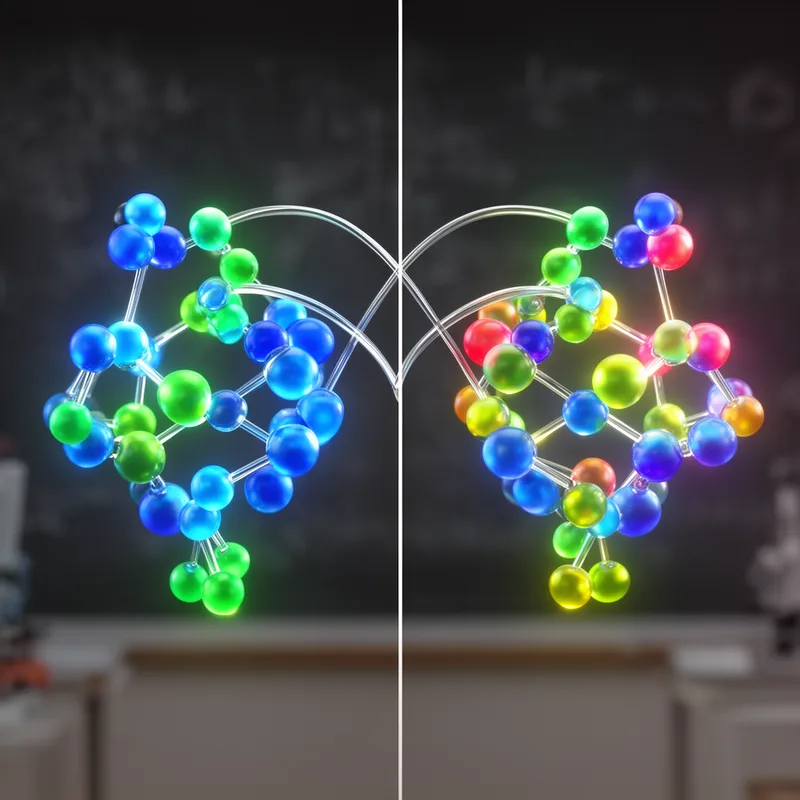
The word isomorphism comes from the parts iso- 'equal' and morph 'form', so it literally means 'equal form'. In mathematics, an isomorphism is a perfect match between two structures that keeps how their parts relate to each other, so you can treat them as the same in structure.