
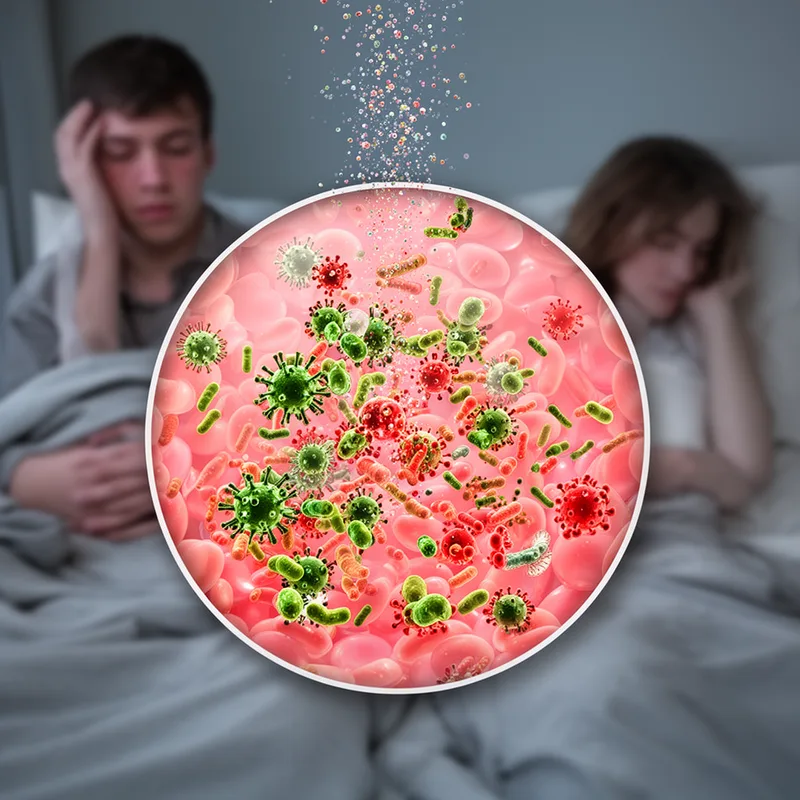
infective agent


 1
5.1
1
5.1
- noun
- /ɪnˈfɛktɪv ˈeɪdʒənt/
- Specialized
- Vaccines help the body recognize and fight against potential infective agents like viruses and bacteria.
Examples
-
Soil-transmitted helminths are some of the most common and infective agents of mankind and are responsible for high morbidity and mortality throughout the developing world.
Academic text (2007) -
Endemic KS would then occur in exposed individuals who harbor the KS infective agent and are susceptible to the KS phenotype (males).
Academic text (1994) -
Other features point to the participation of a low-grade, possibly sexually transmitted infective agent that becomes more pathogenic in the presence of immunosuppression.
Academic text (1994) -
The epidemiology of KS suggests a sexually transmissible, opportunistic, infective agent.
Academic text (1994) -
DIAGRAM: Figure 3: Aetiological relationships between classical, endemic, and epidemic KS and exposure to the KS infective agent, gender, and immune suppression.
Academic text (1994) -
Using fingernails to 'pinch' out the tick poses similar risks to the person who has been bitten and to the person removing the tick, as the infective agent can enter the body through splits in the skin or nail bed.
Academic text (2014) -
A virus can be an infective agent that spreads quickly among populations.
-
Bacteria are often considered infective agents because they can cause illnesses in humans.
Synonyms
 50
5.7
50
5.7
A tiny germ like a virus or a bacterium that causes disease in people and animals
 5
4.2
5
4.2
A tiny living thing like a virus or bacterium that can make people and animals sick
Antonyms

Surface Forms
Morphology
The meaning is directly compositional: 'infective' = able to transmit infection and 'agent' = an entity responsible for an effect, so together they denote an entity that causes infection. This adjective+noun pattern is standard and cross-linguistically common, so a B1 learner who knows both constituents would readily infer the intended meaning.
Etymology
Infective agent creates the image of a tiny agent sneaking into the body and spreading germs. That's why it means 'a microorganism or substance that causes infection'.