

inert
 7
5.5
7
5.5

- adjective
- /ɪˈnɜrt/
- But it all started with that sort of empty piece of land that is totally inert until you do something with it.
- inert and passive
- inert and lifeless
- an inert body
Loading YouTube…
Watch on YouTubeAnd so it makes you kind of apathetic and inert a lot of the time.
- And so it makes you kind of apathetic and inert a lot of the time.
- And even more so, he says, since these things are not themselves dead, inert things, but restless movements.
- Yeah, well, they they should, because I'm completely inert.
- So my thing is intelligence is inert unless you give it an impulse.
- But not just those those kind of inert things, but there's also flora and fauna.
- Without that, we're listless, bored, amotivated, disinterested, inert.
- Don't let me lay here inert, ugly, cold, with nothing sweet felt and nothing harsh told.
- The symbolism of Kali striding over Shiva reflects her superiority as without her he would remain inert and the universe itself would perish.
- But that talent pool was inert, did not have science and technology, did not care about science and technology.
- And we imagine it therefore to be inert and yet it's actually very active in helping organize the cells.
- Nowadays it's don't text them, just be an inert cool girl object with no needs.
- We call them mounds, which kind of, you know, makes them inert.
- And remember that we we've learned now that it was not just something inert.
- And the recipients are relatively inert.
- And so if your DNA is so tightly wound that you can't actually read it, then it's inert.
- Things got if possible worse in one bedroom, lying in a single bed or two inert women.
- Otherwise, you're just an inert chunk of randomly assembled molecules drifting wherever the universe blows you.
Examples
-
And so it makes you kind of apathetic and inert a lot of the time.
-
When the world becomes flat, lifeless, and inert, what can we do to recover or renew our vision?
Academic text (1995) -
In its present state it's completely inert.
-
The body lay almost inert on the floor, but the flesh rose and fell.
Fiction book (1994) -
Society becomes static and inert when its outlook on life stops building up.
Fiction book (1991) -
The Wisdom amulet lay inert beneath her hand, and nothing came to mind.
Fiction book (1992) -
The smooth metal seemed inert, with no moving parts, nothing that Crusher recognized as mechanical.
Fiction book (1992) -
Without transference, learning is sterile or inert and holds no utilitarian value.
Academic text (1990) -
The patient lay inert in the hospital bed, unresponsive to the doctors' calls.
-
During the winter, many animals remain inert, conserving energy until spring.
Synonyms
 ∞
1.0
∞
1.0
Not moving or making a sound
 46
2.9
46
2.9
Not moving and staying in one place
 41
3.0
41
3.0
Completely still with no movement, like a statue
 30
3.9
30
3.9
Moving or working slowly and with little energy
 14
4.4
14
4.4
Not able to move or be moved, like a statue
 12
8.1
12
8.1
Not moving or changing for a time
 4
2.3
4
2.3
Not moving and not showing much physical or mental energy
 1
8.2
1
8.2
To move slowly and have little energy or interest
 1
2.2
1
2.2
Completely still and keeping the same position


 1
3.0
1
3.0
Staying in the same place and not changing position

Showing little energy or excitement

Completely still and not changing position
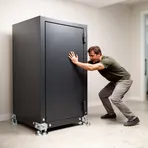
Unable to move or be moved easily

Cannot be moved physically or in opinion
Antonyms

Compounds

How Active

Surface Forms
Etymology
The word inert comes from Latin in- 'not' and ars 'skill' or 'power', so it originally meant 'without power' or 'not able to act'. That's why when someone feels inert they are motionless or lack the energy or will to act.