

nonmoving


 1
3.0
1
3.0
- adjective
- /nɒnˈmuːvɪŋ/
- It suppresses aphids, lepidopterans (both eggs and small larvae), and a variety of other slow or nonmoving, soft-bodied arthropods.
- a nonmoving party
Examples
-
29. The nonmoving party must come forward with more than a mere scintilla of evidence in support of its position.
Academic text (1995) -
28 No genuine issue of material fact exists where the record taken as a whole could not lead a rational trier of fact to find for the nonmoving party.
Academic text (1995) -
30 Evidence presented by the nonmoving party must be adequate to support a finding by a reasonable fact-finder. 31 The nonmoving party has not met the burden of production through presentation of "testimony that an event 'could have happened' or was 'possible,'" 32 or even that an event "must have" happened.
Academic text (1995) -
30 Evidence presented by the nonmoving party must be adequate to support a finding by a reasonable fact-finder. 31 The nonmoving party has not met the burden of production through presentation of "testimony that an event 'could have happened' or was 'possible,'" 32 or even that an event "must have" happened.
Academic text (1995) -
Further on the horizon are nonmoving actuators, such as those using acousto-optic or electro-optic beam deflection.
Academic text (1996) -
The statue stood in the garden, a nonmoving reminder of the artist's talent.
-
During the storm, the trees remained nonmoving, braving the fierce winds.
-
The nonmoving car was parked safely at the side of the road, away from traffic.
Synonyms
 46
2.9
46
2.9
Not moving and staying in one place
 41
3.0
41
3.0
Completely still with no movement, like a statue
 14
4.4
14
4.4
Not able to move or be moved, like a statue
 7
5.5
7
5.5
Not moving and without the energy or will to act
 4
2.3
4
2.3
Not moving and not showing much physical or mental energy
 1
2.2
1
2.2
Completely still and keeping the same position
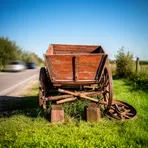
Not moving and fixed in one place

Completely still and not changing position

Stays the same and does not change
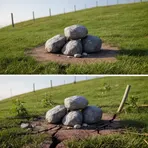
Not moved or changed from where it was before

Cannot be moved physically or in opinion
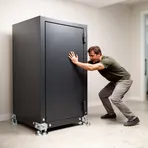
Unable to move or be moved easily
Antonyms

How Mobile

Surface Forms
Morphology
Etymology
The word nonmoving is made of non- ('not') and moving, from the word 'move' meaning 'to change place or position'. So nonmoving means 'not moving', something that stays in the same place.