

inductance
- noun
- /ɪnˈdʌktəns/
- Specialized
- In a circuit, the inductance can cause a delay in the current response due to its property of opposing changes in flow.
- inductance and capacitance
- inductance and resistance
- loop inductance
Loading YouTube…
Watch on YouTubeOf course, the smaller the metal, the less impact it has on the inductance and it's harder to detect.
- Of course, the smaller the metal, the less impact it has on the inductance and it's harder to detect.
Examples
-
It's got some inductance L measured in Henry's.
-
Table 5 also shows the calculated high-frequency inductances L11 and L12.
Academic text (1995) -
A henry is a measure of electric inductance.
Academic text (2000) -
Of course, the smaller the metal, the less impact it has on the inductance and it's harder to detect.
-
The self-inductance represents an additional load in series with the resistance of the net.
Academic text (1999) -
Therefore, a much smaller inductance produces a relatively strong interbit coupling.
Academic text (2005) -
Respectively, R, L, C, and G are the line resistance, inductance, capacitance, and dielectric conductance per unit length.
Academic text (1995) -
The inductance is measured in henries, which quantifies the electromotive force generated by changing current.
-
When designing electrical components, engineers must consider inductance to ensure proper functioning of the circuit.
Compounds

- Specialized
A unit for measuring how much an electric circuit makes voltage when current changes, like the henry

- Specialized
A measure of how much one circuit causes a voltage in another nearby circuit when current changes
- Specialized
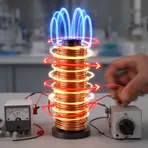
A coil property that makes a changing electric current create a voltage in itself
How Inductive
- Specialized
 1
9.4
1
9.4


- Specialized
28
4.9
- Specialized
- Specialized
63
4.1
700
1.0
Surface Forms
Morphology
Etymology
Inductance comes from induce, which is built from in- 'into' and ducere 'to lead', the same root you see in conduct and duct. So, inductance is the property that 'leads to' or 'causes' a voltage when the current changes.