

mutual inductance
- noun
- /ˈmjuːtʃuəl ɪnˈdʌktəns/
- Specialized
- The mutual inductance between the two coils allows a small current to create a larger voltage in the second coil.
Examples
-
The mutual inductance of the transformer is critical for its performance in converting voltage levels.
-
Engineers often calculate the mutual inductance to ensure efficient energy transfer between circuits.
-
The noise voltage V_m generated by the mutual inductance is due to the dI/dt on the perp net.
Academic text (1999)
Synonyms
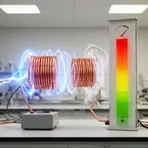
A number showing how much a changing current in one coil makes a voltage in another coil
Surface Forms
Morphology
The phrase is a straightforward adjective+noun composition: 'mutual' (shared between two parties) modifies 'inductance' (the property causing an EMF when current changes), so a learner who knows both words can infer it denotes the inductance that exists between two circuits. Although the full technical details (ratio, units) are specialized, the core meaning is directly derivable from the constituents and follows a common cross‑linguistic compositional pattern.
Etymology
Mutual inductance comes from a simple image of two wire coils close together: when the current in one coil changes, its magnetism reaches the other coil and makes a voltage there. So, mutual means 'shared' and inductance is the power to 'make a voltage' when current changes, and mutual inductance measures how well one coil can make a voltage in the other.

