
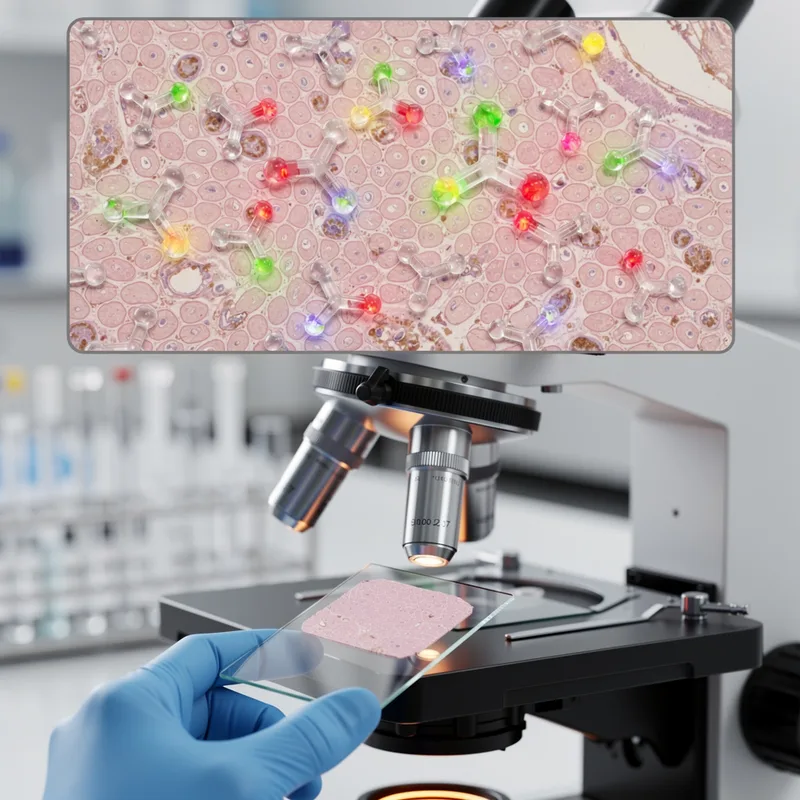
immunohistochemistry
 1
9.0
1
9.0

- noun
- /ˌɪmjuːnoʊˌhɪstəˈkɛmɪstri/
- Specialized
- Most tumor cells express myoepithelial differentiation on either immunohistochemistry or electron microscopy.
- immunohistochemistry staining
- immunohistochemistry shows cytokeratin
- immunohistochemistry was positive
Examples
-
Results of estrogen receptor and c-erbB-2 status using immunohistochemistry were documented.
Academic text (2007) -
Tissue sections were first subjected to two-color immunohistochemistry with two different specific antibodies.
Academic text (2003) -
The results of the histological examination, including immunohistochemistry, were also recorded.
Academic text (2007) -
Strong positivity was also observed on immunohistochemistry for CD68.
Academic text (2003) -
APHIS had already used the "gold standard" diagnostic immunohistochemistry test, which was originally developed by ARS.
Academic text (2004) -
Application of ancillary techniques like immunohistochemistry and flow cytometry then becomes imperative.
Academic text (2007) -
Therefore, diagnosis requires a high index of suspicion, an adequate amount of biopsy material, and immunohistochemistry.
Academic text (2006) -
All images were acquired and quantified in a blinded fashion. Immunohistochemistry was performed on free-floating sections following standard procedures.
Academic text (2018) -
Sinonasal lymphomas are uncommon malignancies. They are difficult to differentiate from carcinomas, and immunohistochemistry is needed to make the diagnosis.
Academic text (2006) -
The researcher used immunohistochemistry to identify the specific proteins in the cancerous tissue sample.
Synonyms
 1
7.2
1
7.2
A lab test that uses antibodies to find or measure proteins in samples like blood

 1
9.6
1
9.6
A lab method that uses glowing antibodies to show specific proteins in cells or tissue
 1
7.8
1
7.8
A lab method that uses antibodies to show where specific proteins are in cells or tissue

A lab method using a first antibody and a glowing second antibody to show targets under a special microscope

A lab test that uses antibodies to find or measure proteins in body samples
How Sensitive
- Specialized

- Specialized
1
8.7
- Specialized
1
9.0
- Specialized
Surface Forms
Morphology
immunohistochemistry = histochemistry (opaque) = immuno + histo + chemistry
The term is a specialist technical formation ('immuno-' + 'histochemistry'); the combining forms are domain-specific and not readily interpretable by an average B1 learner.
Etymology
Immunohistochemistry comes from three parts: immuno- meaning 'immune' or 'defense', histo- meaning 'tissue', and chemistry meaning 'chemical methods'. So, immunohistochemistry is a method that uses the body's immune tools and chemical tags to find and show specific things in tissue samples, which is why doctors and scientists use it to spot disease.