

indirect immunofluorescence
- noun
- /ˌɪndəˈrɛkt ˌɪmjunəˈflɔrəˌsɛns/
- Specialized
- The study employed indirect immunofluorescence to visualize the cellular localization of the antigen under a fluorescence microscope.
- titre by indirect immunofluorescence
- indirect immunofluorescence and indirect haemagglutination
Examples
-
Blood samples collected by fingerprick on filter paper were eluted and processed by serological tests (indirect immunofluorescence, indirect haemagglutination, and ELISA) in parallel (Figure 1).
Academic text (1997) -
ELISA mean absorbance and log mean titres by indirect immunofluorescence and indirect haemagglutination (with 95% CI) were compared between the treatment groups at different times.
Academic text (1997) -
IIF = indirect immunofluorescence; IHA = indirect haemagglutination.
Academic text (1997) -
Serodiagnosis of NE relies on conventional indirect immunofluorescence to detect IgG against Puumala virus.
Academic text (1991) -
Error bars indicate 95% CI. IIF = indirect immunofluorescence; IHA = indirect haemagglutination.
Academic text (1997) -
IFAT, indirect immunofluorescence antibody test; IHA, indirect hemagglutination antibody test.
Academic text (2013) -
For example, at the end of the trial, by indirect immunofluorescence, the median reciprocal titre for the benznidazole group was 320 and that for the placebo group was 2560 (Figure 3).
Academic text (1997) -
In the lab, we used indirect immunofluorescence to detect the presence of specific antibodies in the patient's serum.
-
Researchers demonstrated indirect immunofluorescence as an effective method for identifying viral infections in tissue samples.
Synonyms


 1
9.6
1
9.6
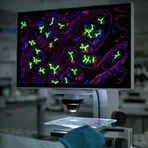
A lab method that uses glowing antibodies to show specific proteins in cells or tissue
Surface Forms
Morphology
The term is compositionally transparent: 'immunofluorescence' denotes a fluorescent-label method for detecting antigens, and 'indirect' signals that the detection is mediated via an intermediate (e.g., a secondary antibody) rather than applied directly. This modifier+noun relationship follows normal English semantics, so a learner who knows both constituent meanings can infer the basic procedure.
Etymology
Indirect immunofluorescence is like a two-step glow trick in the lab: a first finder, the primary antibody, sticks to the target antigen. Then a second helper, the secondary antibody with a fluorescent tag, sticks to the first and makes it 'light up', so the lab can 'see' the antigen.