
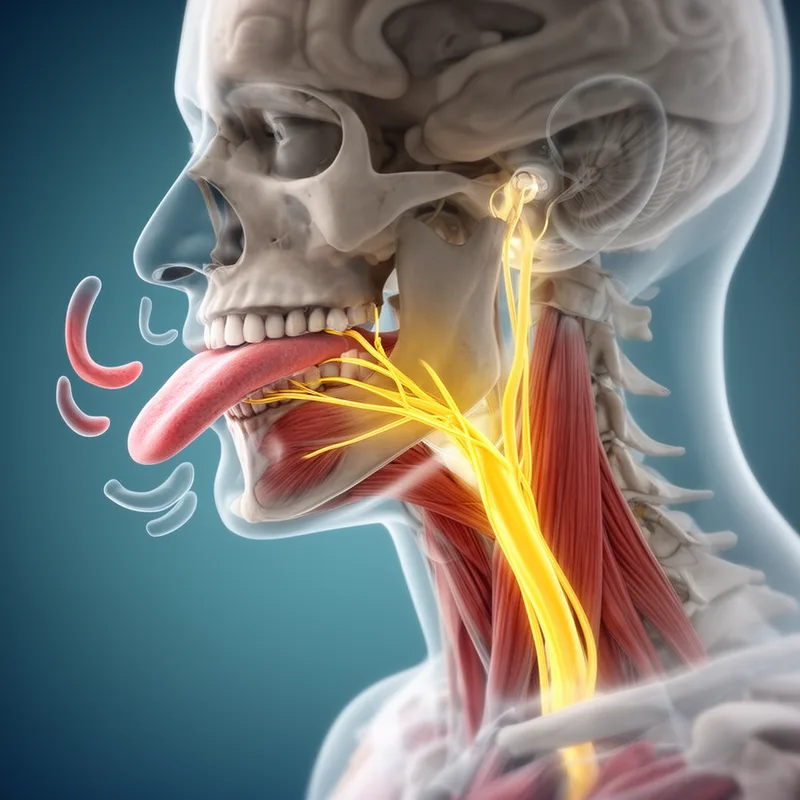
hypoglossal nerve


 1
6.4
1
6.4
- noun
- /ˌhaɪpəˈɡlɑsəl nɜrv/
- Specialized
- Damage to the hypoglossal nerve can result in difficulties with swallowing and speaking.
- lingual and hypoglossal nerve
Examples
-
In a neurological examination, the strength of the hypoglossal nerve is tested by asking the patient to stick out their tongue.
-
To find the hypoglossal nerve, follow it backward...
-
Following surgery, the patient demonstrated vagal and hypoglossal nerve deficits.
Academic text (2005) -
The marginal mandibular, lingual, and hypoglossal nerves were identified and preserved.
Academic text (1996) -
The hypoglossal nerve is closely adherent... to the inferior ganglion of the vagus.
-
Intraoperative findings confirmed tumor involvement of the left lingual artery and the left hypoglossal nerve.
Academic text (2003) -
The fistula would then descend, after looping over the hypoglossal nerve, to open in the skin of the neck at the anterior lower portion of the sternocleidomastoid muscle.
Academic text (2004) -
The branchial tract then courses superiorly over the hypoglossal nerve and descends posteriorly to the common carotid artery.
Academic text (2008) -
The right and left lingual arteries were subsequently ligated and divided, and resection of the subtotal tongue base with preservation of the right hypoglossal nerve was completed.
Academic text (2003) -
Tracing the tract superiorly requires great care, as the natural course of the tract is over the hypoglossal nerve and between the internal and external carotid arteries (Figure 2).
Academic text (1995)
Synonyms

A nerve that controls tongue movement

A nerve that controls the muscles of the tongue

A nerve that controls the muscles of the tongue
Surface Forms
Morphology
This is a straightforward adjective + noun composition: 'hypoglossal' denotes the tongue-related (twelfth cranial) nerve and 'nerve' names a neural fiber tract, so together they specify the nerve that serves the tongue. Although the term is technical, its meaning is directly derivable from the known constituents, so a learner who knows both words will understand it.
Etymology
Hypoglossal nerve comes from Greek parts hypo meaning 'under' and glossal meaning 'tongue'. The nerve runs under the tongue to move it, so the name means the nerve that controls the tongue.