

hypoglossal
- noun
- /ˌhaɪpəˈɡlɑsəl/
- Specialized
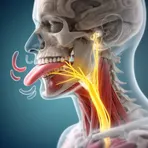
- The hypoglossal nerve controls the movement of the tongue during speech.
- hypoglossal nerve
Examples
-
For example, performing external carotid artery ligation risks damage to the hypoglossal and vagus nerves.
Academic text (2005) -
Because of its central location and proximity to the lingual artery and hypoglossal nerve, excision was not favored, and local radiation therapy was successful.
Academic text (2007) -
Again, the tumor had invaded the occipital condyle and the hypoglossal canal on the left.
Academic text (2008) -
The tumor extended laterally to the left and involved the occipital condyle and the hypoglossal canal on that side.
Academic text (2008) -
Six months postoperatively, the patient was readmitted for a hypoglossal-facial nerve anastomosis.
Academic text (2001) -
Although the hypoglossal deficit abated over 3 months, the patient continued to experience mild inspiratory dyspnea on exertion.
Academic text (2005) -
Main descending pathway: HVC, higher vocal center; RA, robust nucleus of the archistriatum; and nxIIts, tracheosyringeal portion of the hypoglossal motor nucleus.
Academic text (1994) -
The patient was advised that sacrifice of the lingual arteries and hypoglossal nerves bilaterally might be required in order to achieve complete tumor resection, and consent was obtained for possible total glossectomy.
Academic text (2003) -
Damage to the hypoglossal nerve can result in difficulty speaking and swallowing.
-
During the surgery, the doctor carefully monitored the hypoglossal nerve to avoid complications.
Synonyms


 1
6.4
1
6.4
A nerve that controls most movements of the tongue

A nerve that controls the muscles of the tongue

A nerve that controls the muscles of the tongue
Compounds
Surface Forms
Etymology
The word hypoglossal comes from Greek parts hypo- meaning 'under' and glossa meaning 'tongue', and you can see the same gloss- in glossary, which is all about words. So the hypoglossal is the nerve 'under the tongue' that controls tongue movement.