
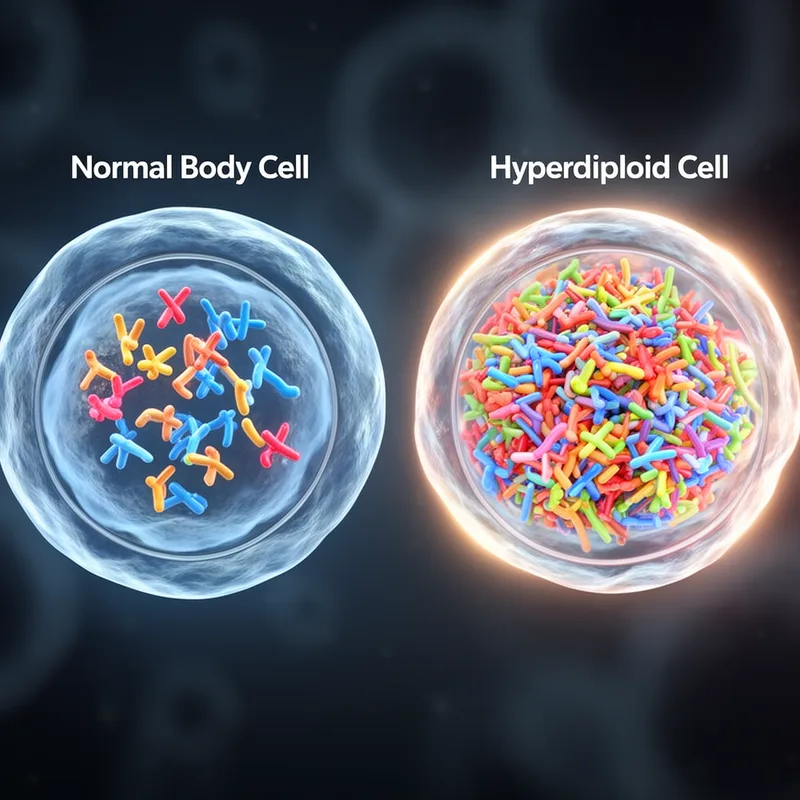
hyperdiploid
- adjective
- /ˌhaɪpərˈdɪplɔɪd/
- Specialized
- In one study by Biselli et al., 5 of 9 tumors were diploid, 4 were hyperdiploid, and in about half of the cases, aneuploidy was associated with more aggressive tumor behavior. These studies were all done in the IMT subtype of IPT.
Examples
-
Certain types of tumors are classified as hyperdiploid due to their increased chromosome count.
-
Researchers found that hyperdiploid cells can contribute to the development of various cancers.
-
The presence of hyperdiploid conditions in cells may indicate a higher risk of genetic abnormalities.
Synonyms
A cell or organism with the wrong number of chromosomes
A living thing or cell with a number of chromosomes that is not a whole multiple of the usual set
Surface Forms
Morphology
hyperdiploid = diploid (semi-transparent) = hyper + di + ploid
The word transparently means 'more than diploid', but it is a specialized biological term and depends on the technical base 'diploid'.
Etymology
Hyperdiploid comes from the parts hyper- ('over' or 'too much') and diploid (from a root meaning 'double' or 'two sets'). Just like hyper- in hyperactive, it means 'more than normal', and diploid points to the normal 'two sets' of chromosomes, so hyperdiploid describes cells that have more than the usual two sets of chromosomes.

