
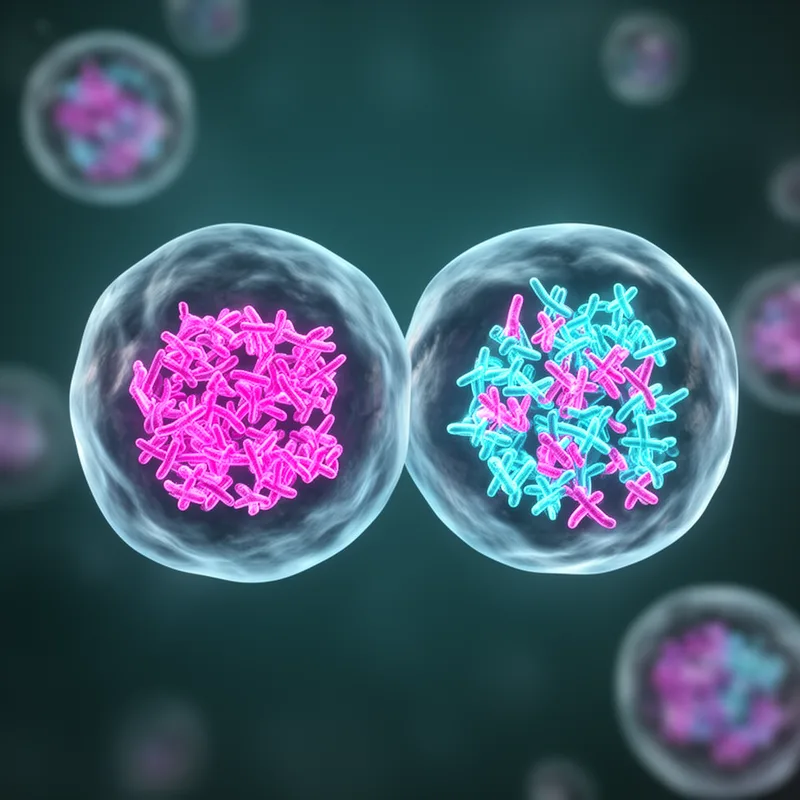
aneuploid
- adjective
- /ˈeɪnjuˌplɔɪd/
- Specialized
- Researchers are studying how aneuploid conditions can affect cell function.
Examples
-
The tumor was found to be aneuploid.
-
Are the cells aneuploid or diploid?
-
Certain types of cancer are characterized by aneuploid chromosome numbers.
-
The scientist discovered that the sample contained aneuploid cells.
-
Many tumors are aneuploid, which can lead to unpredictable growth patterns.
-
Researchers found that aneuploid cells often exhibit abnormal behaviors compared to normal diploid cells.
-
In certain species, aneuploid conditions are linked to developmental disorders in offspring.
Surface Forms
Morphology
aneuploid = euploid (opaque) = an + euploid
Formed by the negative prefix 'an-' attached to the technical base 'euploid'; the term is highly domain-specific and not derivable by most learners from its parts.
Etymology
Aneuploid breaks into a- meaning 'not' and -ploid meaning 'set', as in diploid 'two sets' and haploid 'one set'. So an aneuploid cell has 'not the usual number of chromosomes'.

