
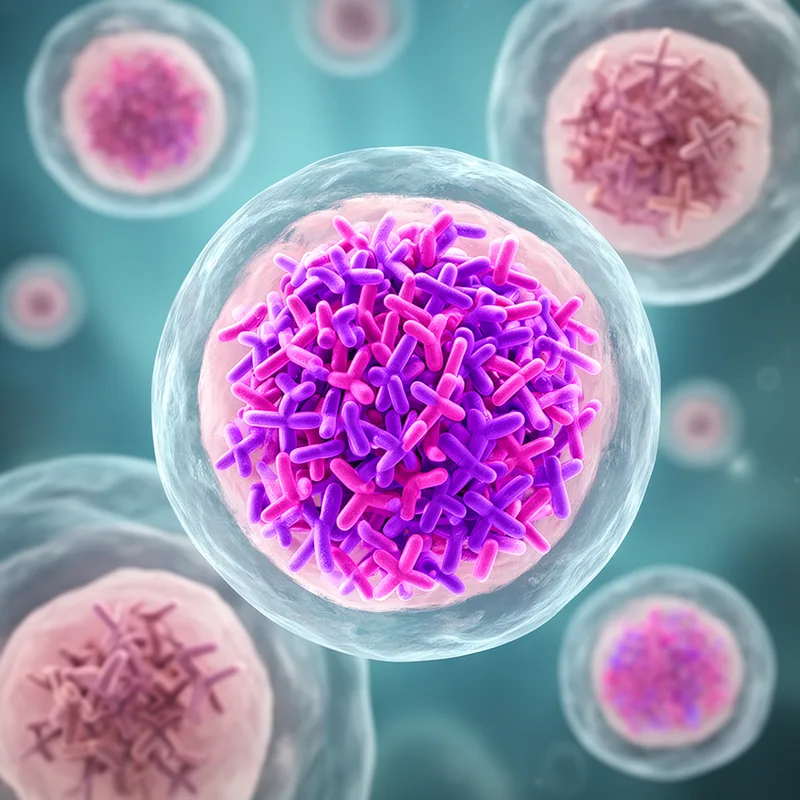
hyperdiploid
- noun
- /ˌhaɪpərˈdɪplɔɪd/
- Specialized
- A hyperdiploid can indicate a specific genetic abnormality in cancer cells.
Examples
-
A hyperdiploid cell can lead to various genetic disorders.
-
Researchers identified a hyperdiploid in the patient's bone marrow sample.
-
The doctor explained that a hyperdiploid is often found in certain types of leukemia.
-
Many cancers are associated with hyperdiploid cells.
-
The researchers discovered a hyperdiploid organism that exhibited unusual growth patterns.
-
In the study, a hyperdiploid cell was identified to have significant genomic alterations.
-
Scientists are examining hyperdiploid cells to understand their role in certain cancers.
Surface Forms
Morphology
hyperdiploid = diploid (semi-transparent) = hyper + di + ploid
The noun sense is a technical substantivization of the same transparent biological formation, but it remains specialized terminology.
Etymology
Hyperdiploid comes from the parts hyper- ('over' or 'too much') and diploid ('double' or 'two sets'), so a hyperdiploid (as a noun) is a cell or organism that has more than the normal two sets of chromosomes.

